



About Us
China to Bharat is the only professional group of companies who can be your import export agents from China to India imports for full or loose container cargo load.
Gallery
Social Account



Import Duty & GST Calculation for Chinese Imports in 2026: Complete Guide to Customs Charges & Landed Cost
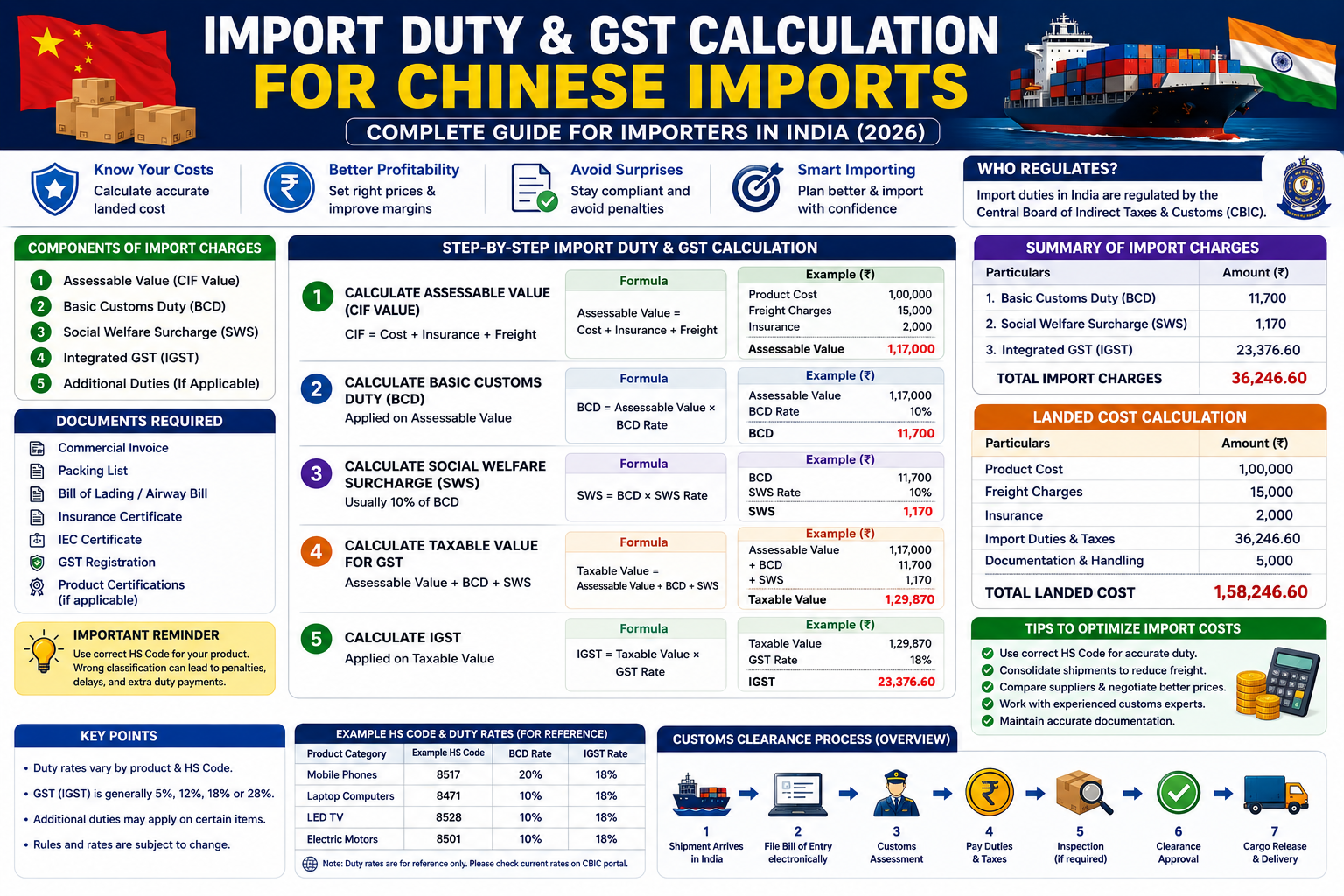
Import Duty & GST Calculation for Chinese Imports (Complete Guide 2026)
When importing products from China to India, understanding import duty and GST calculations is essential for determining your actual product cost and profit margins. Many importers focus only on product prices and shipping costs, but customs duties and taxes can significantly impact the final landed cost of imported goods.
Whether you’re importing electronics, machinery, consumer goods, industrial equipment, or eCommerce products, accurate duty calculation helps avoid unexpected expenses and customs-related issues.
This guide explains how import duty and GST are calculated for Chinese imports into India.
🛃 What is Import Duty?
Import duty is a tax imposed by the Indian government on goods entering the country from abroad.
The primary objectives are:
- Protect domestic industries
- Generate government revenue
- Regulate international trade
- Ensure fair competition
Import duty rates vary depending on:
- Product category
- HS Code classification
- Product value
- Applicable government regulations
📦 Why Understanding Import Duty Matters
Knowing import duties helps businesses:
- Calculate total landed costs
- Set accurate selling prices
- Estimate profitability
- Avoid customs surprises
- Improve financial planning
Without proper calculations, importers may underestimate actual costs.
🌍 Who Regulates Import Duties in India?
Import duties are administered by the Central Board of Indirect Taxes and Customs.
The customs department assesses imported goods based on:
- Product classification
- Transaction value
- Applicable tax rates
📋 Understanding HS Codes
Every imported product is assigned an HS Code (Harmonized System Code).
HS Codes determine:
- Duty rates
- GST rates
- Compliance requirements
- Product classification
Examples include:
- Electronics
- Mobile accessories
- Machinery
- Textiles
- Furniture
Using the correct HS Code is critical.
Incorrect classification may lead to:
- Penalties
- Delays
- Additional inspections
💰 Main Components of Import Charges
Import taxes generally consist of:
1. Assessable Value
2. Basic Customs Duty (BCD)
3. Social Welfare Surcharge (SWS)
4. Integrated GST (IGST)
5. Additional Duties (if applicable)
Let’s understand each component.
Step 1: Calculate Assessable Value
The assessable value forms the basis for customs calculations.
Typically calculated as:
CIF Value
CIF stands for:
- Cost
- Insurance
- Freight
Formula:
Assessable Value = Product Cost + Insurance + Freight Charges
Example:
Product Cost = ₹1,00,000
Freight = ₹15,000
Insurance = ₹2,000
Assessable Value = ₹1,17,000
This value becomes the foundation for duty calculations.
Step 2: Calculate Basic Customs Duty (BCD)
BCD is applied to the assessable value.
Formula:
BCD = Assessable Value × Duty Rate
Example:
Assessable Value = ₹1,17,000
BCD Rate = 10%
BCD = ₹11,700
Step 3: Calculate Social Welfare Surcharge (SWS)
SWS is usually calculated as a percentage of BCD.
Formula:
SWS = BCD × Applicable Rate
Example:
BCD = ₹11,700
SWS Rate = 10%
SWS = ₹1,170
Step 4: Calculate Taxable Value for GST
GST is calculated on:
Assessable Value + BCD + SWS
Example:
₹1,17,000 + ₹11,700 + ₹1,170
Taxable Value = ₹1,29,870
Step 5: Calculate IGST
IGST is applied to the taxable value.
Formula:
IGST = Taxable Value × GST Rate
Example:
Taxable Value = ₹1,29,870
GST Rate = 18%
IGST = ₹23,376.60
📊 Complete Import Duty Calculation Example
Suppose you import products from China.
Product Value
₹1,00,000
Freight Charges
₹15,000
Insurance
₹2,000
Assessable Value
₹1,17,000
BCD (10%)
₹11,700
SWS (10% of BCD)
₹1,170
GST Base
₹1,29,870
IGST (18%)
₹23,376.60
Total Import Charges
BCD + SWS + IGST
= ₹36,246.60
📦 Landed Cost Calculation
Product Cost
₹1,00,000
Freight
₹15,000
Insurance
₹2,000
Import Taxes
₹36,246.60
Documentation & Handling
₹5,000
Total Landed Cost
₹1,58,246.60
This is the actual cost before selling the product.
🚢 Products with Different Duty Rates
Import duty rates vary widely.
Examples:
Electronics
May attract higher duty rates.
Machinery
Often has different customs classifications.
Industrial Components
Rates vary depending on product type.
Consumer Goods
May have additional import restrictions.
Always verify current rates before importing.
⚠️ Common Mistakes in Duty Calculation
Wrong HS Codes
Incorrect classification can result in penalties.
Ignoring Freight Costs
Freight forms part of assessable value.
Under-Valuation
Declaring lower values can trigger inspections.
Missing Additional Charges
Documentation and handling fees affect landed cost.
Not Calculating GST Properly
GST applies after customs duty calculations.
📄 Documents Required for Duty Assessment
Commercial Invoice
Shows transaction value.
Packing List
Details shipment contents.
Bill of Lading
Proof of shipment.
Insurance Certificate
Used in CIF calculations.
IEC Certificate
Importer identification document.
GST Registration
Required for tax processing.
💡 Tips to Reduce Import Costs Legally
Choose Correct HS Codes
Avoid overpaying duties.
Consolidate Shipments
Reduce freight costs.
Plan Imports Efficiently
Avoid urgent shipping expenses.
Work with Experienced Customs Experts
Professional guidance helps optimize costs.
Maintain Accurate Documentation
Prevents delays and penalties.
🚚 Role of Freight Forwarders
Freight forwarders assist with:
- Duty estimation
- Customs documentation
- Shipment tracking
- Cargo clearance
Logistics providers like ChinaToBharat help simplify import operations and improve cost transparency.
📈 Why Landed Cost Calculation is Important
Proper landed cost calculations help businesses:
✔ Determine selling prices
✔ Estimate profits
✔ Avoid unexpected expenses
✔ Improve inventory planning
✔ Scale import operations effectively
📝 Conclusion
Understanding import duty and GST calculations is essential for anyone importing products from China to India. Customs duties, GST, freight charges, insurance, and documentation fees all contribute to the final landed cost.
By calculating import taxes correctly, using the right HS Codes, and maintaining accurate documentation, businesses can avoid costly surprises and make better import decisions.
Whether you’re a first-time importer or an experienced trader, proper duty planning is key to building a profitable import business.
❓ Frequently Asked Questions
What is the first step in calculating import duty?
Calculate the assessable value, which includes product cost, freight, and insurance.
Does GST apply to imported goods?
Yes, imported goods are generally subject to IGST based on the applicable product category.
What is an HS Code?
An HS Code is an international product classification code used to determine customs duties and regulations.
Can I reduce import duties legally?
Yes, by using correct product classifications, optimizing logistics, and ensuring compliance with customs regulations.
Why is landed cost important?
Landed cost represents the total cost of importing goods and helps determine profitability accurately.


