



About Us
China to Bharat is the only professional group of companies who can be your import export agents from China to India imports for full or loose container cargo load.
Gallery
Social Account



Future of Logistics & Supply Chain Trends in 2026: Top Innovations Shaping Global Trade
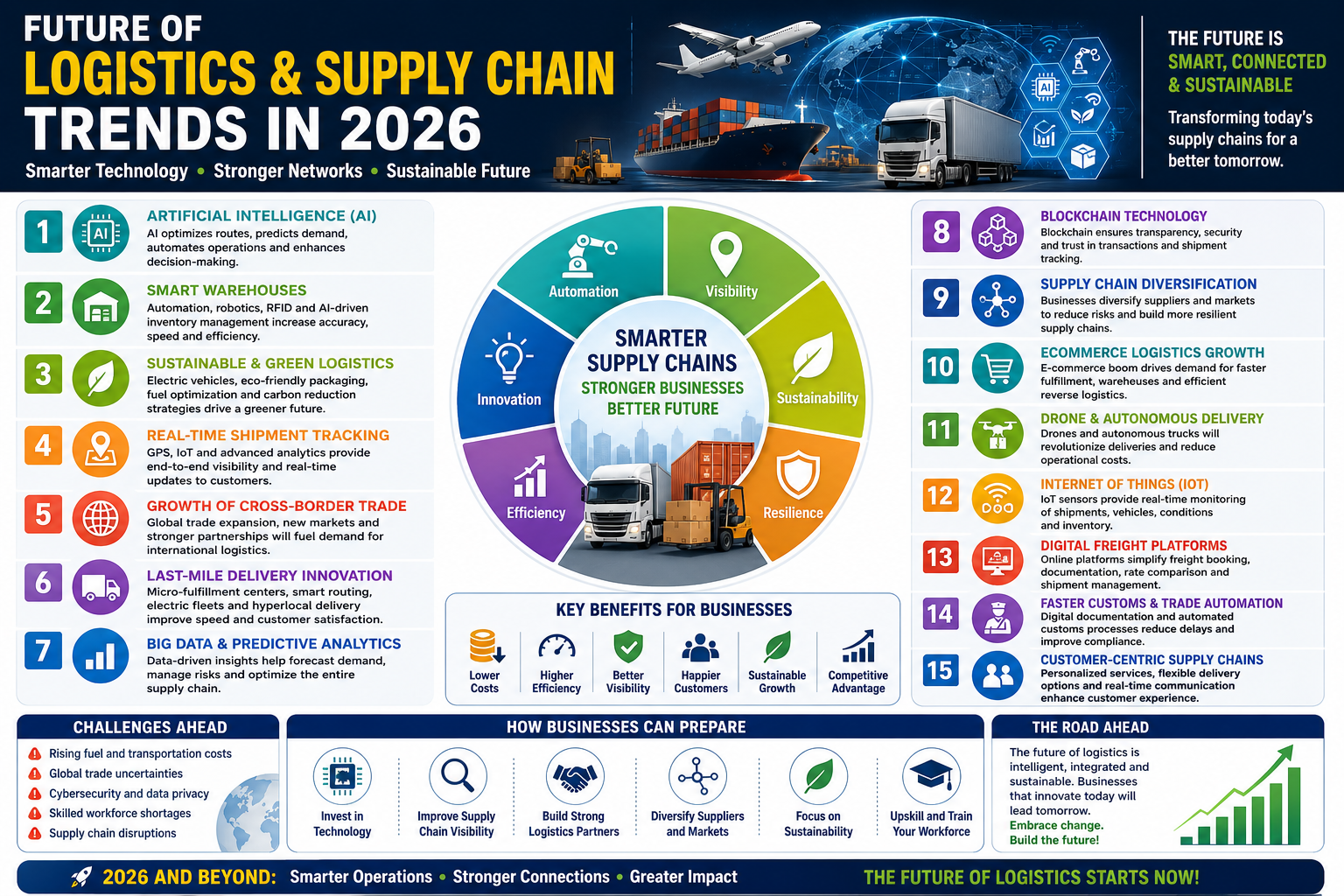
Future of Logistics & Supply Chain Trends in 2026
The logistics and supply chain industry is undergoing a major transformation. Rapid technological advancements, changing customer expectations, global trade expansion, and the growth of e-commerce are reshaping how goods move across the world.
In 2026, businesses that adopt modern logistics solutions will have a significant competitive advantage. From AI-powered operations to smart warehouses and sustainable transportation, the future of logistics is becoming faster, more transparent, and highly efficient.
This guide explores the top logistics and supply chain trends that are expected to define the industry in 2026.
🚚 Why Logistics is Evolving
Modern businesses demand:
- Faster deliveries
- Lower transportation costs
- Real-time shipment tracking
- Better inventory management
- Greater supply chain visibility
To meet these expectations, companies are investing heavily in digital transformation.
🤖 1. Artificial Intelligence (AI) in Logistics
Artificial Intelligence is becoming a core part of logistics operations.
AI Applications
- Route optimization
- Demand forecasting
- Warehouse automation
- Shipment tracking
- Customer support chatbots
Benefits
✔ Reduced operating costs
✔ Faster decision-making
✔ Improved delivery accuracy
✔ Better inventory planning
📦 2. Smart Warehouses
Warehouses are becoming increasingly automated.
Smart Warehouse Technologies
- Automated storage systems
- Barcode scanning
- RFID tracking
- Robotics
- AI inventory management
Advantages
- Faster order processing
- Fewer errors
- Lower labor costs
- Improved productivity
🌍 3. Sustainable and Green Logistics
Environmental responsibility is becoming a business priority.
Green Logistics Practices
- Electric delivery vehicles
- Eco-friendly packaging
- Fuel-efficient transportation
- Carbon footprint reduction
- Route optimization
Many companies are investing in sustainability to reduce costs and comply with environmental standards.
📱 4. Real-Time Shipment Tracking
Customers expect complete visibility of their shipments.
Modern Tracking Features
- GPS monitoring
- Mobile tracking apps
- Live shipment updates
- Delivery notifications
Benefits
- Better customer experience
- Reduced uncertainty
- Improved logistics planning
🚢 5. Growth of Cross-Border Trade
International trade continues to expand.
Countries like China and India are strengthening import-export relationships.
Businesses increasingly rely on:
- Freight forwarding
- Customs brokerage
- International shipping
- Global supply chain management
Cross-border logistics services will continue to grow in 2026.
🚛 6. Last-Mile Delivery Innovation
Last-mile delivery remains one of the biggest logistics challenges.
Emerging Solutions
- Micro-fulfillment centers
- Smart delivery routing
- Electric delivery fleets
- Hyperlocal logistics
Efficient last-mile delivery improves customer satisfaction.
📊 7. Big Data and Predictive Analytics
Data-driven decision-making is becoming essential.
Companies analyze:
- Customer demand
- Shipping patterns
- Inventory trends
- Fleet performance
Predictive analytics helps reduce delays and optimize operations.
🔗 8. Blockchain Technology
Blockchain increases transparency in supply chains.
Potential Benefits
- Secure documentation
- Fraud prevention
- Shipment traceability
- Better record management
Blockchain can simplify international trade documentation.
🏭 9. Supply Chain Diversification
Many businesses are reducing dependence on a single supplier or region.
Strategies
- Multiple suppliers
- Regional warehouses
- Flexible sourcing
- Risk management planning
Diversified supply chains improve resilience.
📦 10. eCommerce Logistics Growth
Online shopping continues to drive logistics demand.
Key developments include:
- Faster order fulfillment
- Same-day delivery
- Automated warehouses
- Reverse logistics
e-commerce logistics will remain one of the fastest-growing sectors.
🚁 11. Drone and Autonomous Delivery
Although still developing, autonomous technologies are advancing rapidly.
Future applications include:
- Drone deliveries
- Self-driving trucks
- Automated cargo handling
These technologies could reduce delivery times and operating costs.
🌐 12. Internet of Things (IoT)
IoT devices provide real-time monitoring across the supply chain.
IoT Applications
- Temperature monitoring
- Vehicle tracking
- Container monitoring
- Fleet management
IoT improves shipment visibility and cargo security.
💻 13. Digital Freight Platforms
Digital logistics platforms connect shippers and carriers efficiently.
Benefits include:
- Instant freight booking
- Online documentation
- Shipment tracking
- Rate comparisons
Digitalization reduces paperwork and manual processes.
🛃 14. Faster Customs and Trade Automation
Governments and logistics providers are adopting digital customs systems.
Benefits include:
- Faster document processing
- Reduced clearance delays
- Better compliance
- Improved transparency
Automation helps international trade move more efficiently.
📈 15. Customer-Centric Supply Chains
Businesses are focusing more on customer experience.
Key priorities include:
- Faster delivery
- Flexible shipping options
- Real-time communication
- Easy returns management
Customer satisfaction is becoming a major competitive advantage.
⚠️ Challenges Facing Logistics in 2026
Despite innovation, businesses may face challenges such as:
- Rising fuel costs
- Global trade disruptions
- Supply chain risks
- Skilled workforce shortages
- Cybersecurity threats
Companies must build resilient supply chains to manage uncertainty.
💡 How Businesses Can Prepare
Invest in Technology
Adopt AI, IoT, and warehouse automation.
Improve Supply Chain Visibility
Track inventory and shipments in real time.
Build Strong Logistics Partnerships
Work with reliable freight and transportation providers.
Diversify Suppliers
Reduce dependency on a single market.
Focus on Sustainability
Implement environmentally friendly logistics practices.
🚀 The Future of China-to-India Trade
Trade between China and India continues to create opportunities for businesses.
Future growth areas include:
- Electronics
- Industrial machinery
- Consumer goods
- eCommerce products
- Smart manufacturing equipment
Efficient logistics and supply chain management will play a crucial role in supporting this growth.
📝 Conclusion
The future of logistics and supply chain management in 2026 is being shaped by technology, automation, sustainability, and digital transformation. Businesses that embrace AI, smart warehousing, IoT, data analytics, and green logistics will be better positioned to compete in a rapidly evolving global market.
As customer expectations continue to rise, companies must focus on speed, transparency, and operational efficiency to build stronger and more resilient supply chains.
❓Frequently Asked Questions
What is the biggest logistics trend in 2026?
Artificial Intelligence and automation are expected to have the biggest impact on logistics operations.
Why is real-time tracking important?
It improves shipment visibility, customer satisfaction, and supply chain planning.
How is AI changing logistics?
AI helps optimize routes, forecast demand, automate warehouses, and improve decision-making.
What is green logistics?
Green logistics focuses on reducing environmental impact through sustainable transportation and packaging.
Why is supply chain diversification important?
It reduces business risks and improves resilience against global disruptions.


