



About Us
China to Bharat is the only professional group of companies who can be your import export agents from China to India imports for full or loose container cargo load.
Gallery
Social Account



Customs Clearance Process in India Explained: Complete Import Guide for 2026
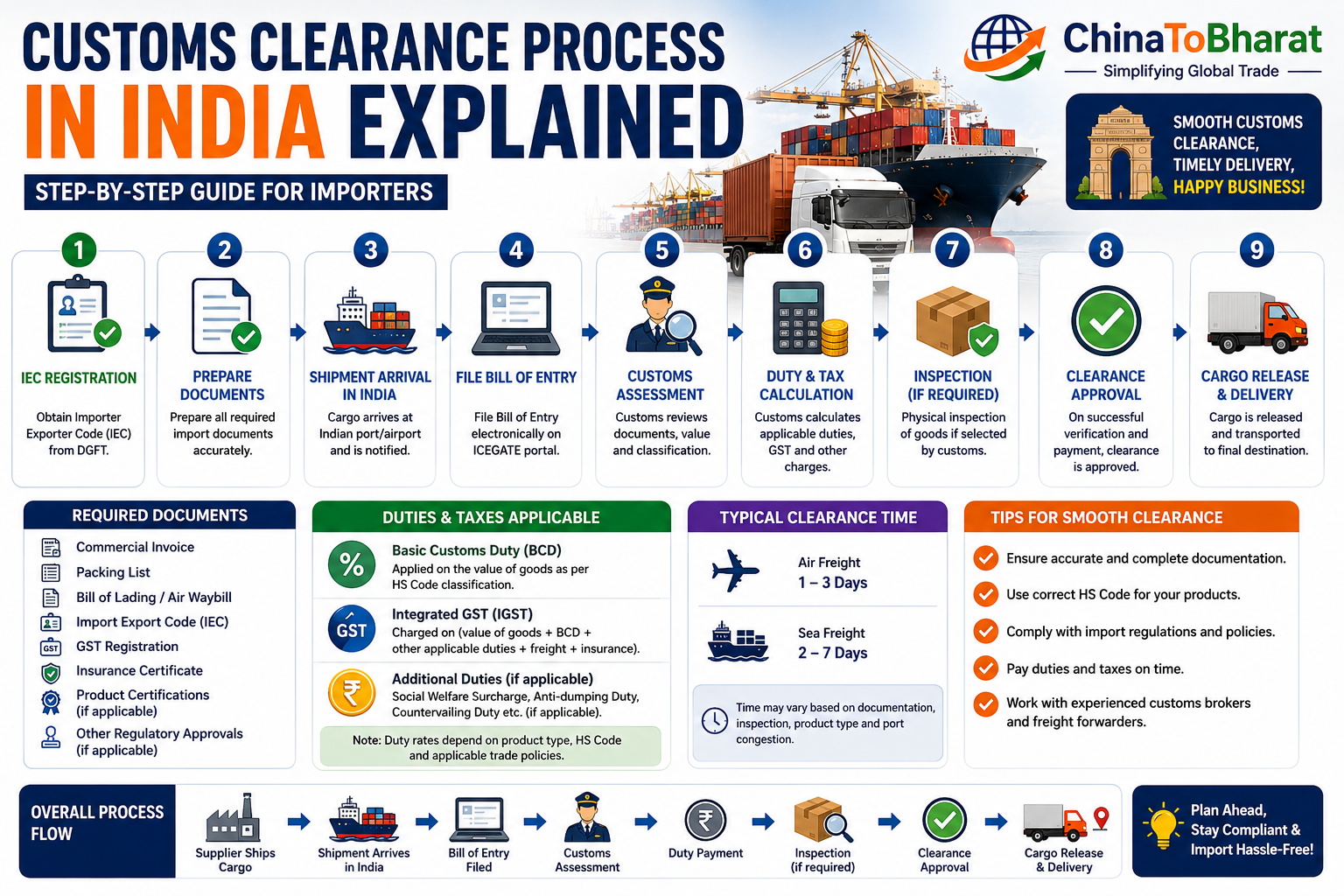
Customs Clearance Process in India Explained: Complete Guide for Importers (2026)
Customs clearance is one of the most important steps in the import process. Every shipment entering India must pass through customs before it can be released for delivery. Whether you’re importing electronics, machinery, consumer goods, or industrial products, understanding the customs clearance process can help you avoid delays, penalties, and unexpected costs.
For many first-time importers, customs procedures can seem complicated. However, once you understand the required documents, duties, inspections, and approval process, importing becomes much easier.
This guide explains the complete customs clearance process in India, step by step.
🛃 What is Customs Clearance?
Customs clearance is the process of obtaining permission from Indian customs authorities to import goods into the country.
The process ensures:
- Import regulations are followed
- Applicable duties and taxes are paid
- Goods comply with Indian laws
- Restricted products are monitored
Without customs clearance, imported cargo cannot be legally released.
🌍 Why Customs Clearance is Important
Customs clearance helps:
- Prevent illegal imports
- Ensure product compliance
- Collect government revenue
- Protect consumers
- Regulate international trade
A smooth customs process ensures timely delivery and lower logistics costs.
📦 When Does Customs Clearance Occur?
Customs clearance begins after the shipment arrives at:
- Seaport
- Airport
- Inland Container Depot (ICD)
The importer or customs broker then submits the required documentation for review.
Step 1: Obtain an Importer Exporter Code (IEC)
Before importing goods into India, businesses need an IEC.
The IEC is issued by the Directorate General of Foreign Trade.
Why is an IEC required
- Mandatory for commercial imports
- Required for customs filing
- Needed for international payments
Without an IEC, customs clearance cannot proceed for commercial imports.
Step 2: Prepare Import Documents
Accurate documentation is essential.
Commercial Invoice
Contains:
- Product details
- Quantity
- Value
- Supplier information
Packing List
Provides:
- Package count
- Weight
- Dimensions
Bill of Lading (Sea Freight)
Acts as proof of shipment ownership.
Air Waybill (Air Freight)
Used for air cargo shipments.
IEC Certificate
Importer identification document.
GST Registration
Required for tax compliance.
Insurance Certificate
Recommended for cargo protection.
Product Certifications
Some products may require:
- BIS certification
- Safety approvals
- Regulatory clearances
Step 3: Shipment Arrival in India
Once cargo arrives at an Indian port or airport:
- Shipping lines notify the importer
- Cargo information enters customs systems
- Documentation review begins
Major ports include:
- Mumbai (Nhava Sheva)
- Chennai
- Mundra
- Kolkata
Step 4: Filing the Bill of Entry
The Bill of Entry is one of the most important customs documents.
It contains:
- Importer details
- Product description
- HS Code
- Shipment value
- Duty calculation
This document is submitted electronically through customs systems.
Step 5: Customs Assessment
Customs officers review:
- Product classification
- Declared value
- Import regulations
- Applicable duties
The assessment determines:
- Customs duty
- GST
- Additional charges
Accurate declarations help prevent delays.
Step 6: HS Code Verification
Every imported product has an HS Code.
HS Codes help customs determine:
- Product category
- Applicable duties
- Regulatory requirements
Incorrect classification can lead to:
- Penalties
- Delays
- Additional inspections
Step 7: Duty and Tax Calculation
Import charges typically include:
Basic Customs Duty (BCD)
Applied according to product classification.
Integrated GST (IGST)
Charged on imported goods.
Additional Duties
Applicable to specific product categories.
The final amount depends on:
- Product value
- Freight cost
- Insurance cost
- HS Code
Step 8: Customs Inspection (If Required)
Some shipments undergo physical inspection.
Customs officers may verify:
- Product description
- Quantity
- Documentation accuracy
- Compliance requirements
Not every shipment is inspected.
Risk assessment systems determine inspection requirements.
Step 9: Customs Clearance Approval
Once customs verifies:
- Documents
- Duties
- Product compliance
The shipment receives clearance approval.
At this stage:
- Cargo is officially released
- Delivery arrangements can proceed
Step 10: Port Handling and Cargo Release
After customs approval:
- Terminal charges are settled
- Shipping line procedures are completed
- Cargo release orders are issued
The importer gains access to the shipment.
Step 11: Inland Transportation
Once released, cargo is transported to:
- Warehouse
- Factory
- Distribution center
- Retail location
Road transportation is commonly used for final delivery.
⏱️ How Long Does Customs Clearance Take?
Typical clearance timelines:
Air Freight
1–3 days
Sea Freight
2–7 days
Time depends on:
- Documentation accuracy
- Inspection requirements
- Product category
- Port congestion
📑 Common Documents Required for Customs Clearance
Mandatory Documents
✔ Commercial Invoice
✔ Packing List
✔ Bill of Lading or Air Waybill
✔ IEC Certificate
✔ GST Registration
Additional Documents
✔ Insurance Certificate
✔ Product Certifications
✔ Purchase Orders
✔ Test Reports
⚠️ Common Reasons for Customs Delays
Incorrect Documentation
Missing or inaccurate paperwork.
Wrong HS Codes
Incorrect product classification.
Under-Valuation
Declaring lower product values.
Regulatory Non-Compliance
Missing certifications or approvals.
Inspection Delays
Additional customs verification.
🚫 Common Customs Clearance Mistakes
Not Understanding Import Duties
Unexpected taxes affect profitability.
Incomplete Documentation
Missing paperwork causes delays.
Incorrect Product Classification
Wrong HS Codes create compliance issues.
Ignoring Compliance Requirements
Some products require special approvals.
Delayed Duty Payments
Can increase storage charges.
💡 Tips for Faster Customs Clearance
Verify Documents Before Shipping
Ensure accuracy.
Use Correct HS Codes
Avoid classification issues.
Work with Experienced Customs Brokers
Professional guidance speeds up clearance.
Understand Product Regulations
Research requirements beforehand.
Respond Quickly to Customs Queries
Fast communication prevents delays.
🚚 Role of Freight Forwarders in Customs Clearance
Freight forwarders help manage:
- Documentation
- Customs filing
- Duty calculations
- Cargo release
- Delivery coordination
Logistics partners like ChinaToBharat can simplify the import process and reduce clearance complications.
📊 Example Customs Clearance Workflow
Supplier Ships Cargo → Shipment Arrives in India → Bill of Entry Filed → Customs Assessment → Duty Payment → Inspection (if required) → Clearance Approval → Cargo Release → Final Delivery
This structured process helps importers receive goods efficiently.
📝 Conclusion
Customs clearance is a critical part of importing goods into India. Understanding the process, preparing accurate documentation, paying duties on time, and complying with regulations can significantly reduce delays and costs.
Whether you are a first-time importer or an experienced business owner, proper customs planning ensures smoother logistics operations and successful international trade.
By following the steps outlined in this guide and working with experienced logistics professionals, you can navigate India’s customs clearance process with confidence and efficiency.


