



About Us
China to Bharat is the only professional group of companies who can be your import export agents from China to India imports for full or loose container cargo load.
Gallery
Social Account



Documents Required for Import from China to India (Complete Guide 2026)
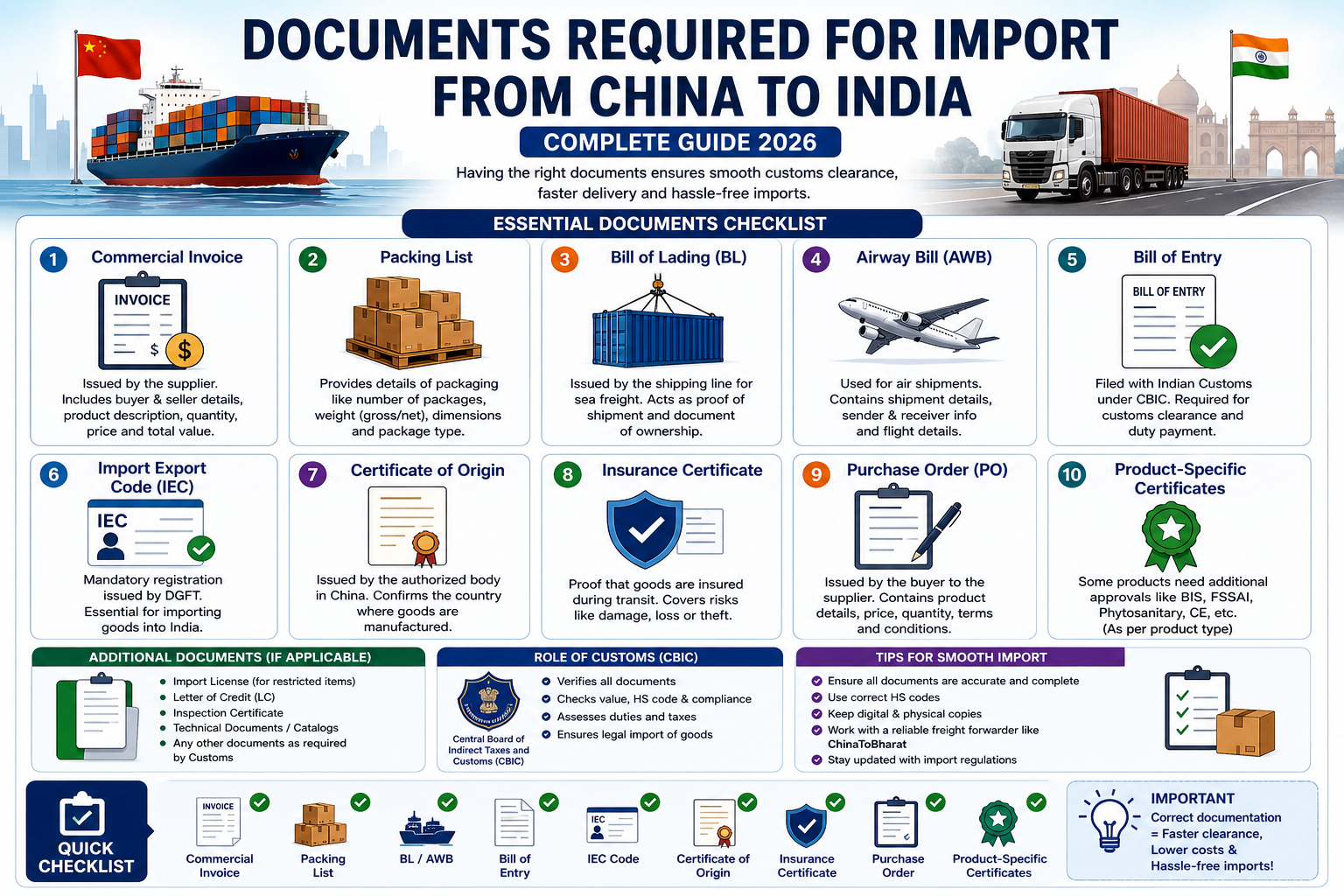
📦 Documents Required for Import from China to India (Complete Guide 2026)
Importing goods from China to India has become one of the most popular business models due to competitive pricing, wide product variety, and strong manufacturing capabilities. However, while the opportunity is large, the process is highly regulated. One of the most critical aspects of successful importing is ensuring that all required documents are accurate, complete, and compliant with Indian regulations.
In this comprehensive 2026 guide, we will walk you through every document required to import goods from China to India, explain their purpose, and help you avoid costly mistakes.
🧾 1. Basic Business Documents (Foundation for Importing)
Before you even think about placing an order with a Chinese supplier, you must ensure that your business is legally eligible to import goods into India.
✅ Importer Exporter Code (IEC)
The Importer Exporter Code (IEC) is a mandatory 10-digit code issued by the Directorate General of Foreign Trade (DGFT). Without IEC, no individual or business can legally import goods into India.
- Required for customs clearance
- Needed for international payments
- Lifetime validity (no renewal required)
👉 This is the first and most important step in your import journey.
✅ GST Registration
If you are importing goods for commercial purposes, having a GST registration is essential.
- Required for claiming input tax credit
- Mandatory for businesses
- Helps in proper tax compliance
✅ PAN Card
A Permanent Account Number (PAN) is required for:
- Financial transactions
- Customs documentation
- Linking business activities with taxation
✅ Authorized Dealer (AD) Bank Account
You must have a current account with a bank authorized to handle foreign exchange transactions.
- Used for making international payments
- Required for remittance documentation
- Linked to RBI compliance
📄 2. Commercial Documents (Transaction Proof)
These documents define the commercial agreement between you and your Chinese supplier.
🧾 Proforma Invoice
This is a preliminary invoice issued by the supplier before shipment.
- Includes product details, pricing, and payment terms
- Used for order confirmation
- Helps in applying for loans or approvals
🧾 Commercial Invoice
The commercial invoice is one of the most important documents in the entire process.
- Final bill issued by the supplier
- Contains product description, value, quantity
- Used by customs to calculate duties
👉 Any mismatch in this document can lead to penalties or shipment delays.
🧾 Purchase Order (PO) / Sales Contract
A purchase order or contract includes:
- Agreed price and quantity
- Delivery timeline
- Payment terms (advance, LC, etc.)
This protects both the importer and exporter legally.
🧾 Letter of Credit (LC)
If you are using bank-mediated payments, a Letter of Credit ensures secure transactions.
- Issued by the buyer’s bank
- Guarantees payment to the supplier
- Reduces risk in international trade
🚢 3. Shipping Documents (Proof of Transportation)
Once your goods are shipped, logistics-related documents come into play.
🚢 Bill of Lading (B/L)
Used for sea shipments, the Bill of Lading serves three main purposes:
- Receipt of goods
- Contract of carriage
- Document of title
👉 Without this, you cannot claim your goods at the destination port.
✈ Airway Bill (AWB)
For air shipments, an Airway Bill replaces the Bill of Lading.
- Faster shipping documentation
- Non-negotiable document
- Used for tracking cargo
📜 Freight Certificate
This document shows:
- Cost of freight
- Mode of transport
- Carrier details
It helps in calculating the total landed cost.
🛡 Insurance Certificate
Marine insurance protects your shipment against:
- Damage
- Theft
- Loss during transit
👉 Always insure your goods, especially for high-value imports.
📦 4. Packaging & Product Information
Proper documentation of packaging and product details ensures smooth customs clearance.
📦 Packing List
The packing list includes:
- Number of cartons
- Weight (gross and net)
- Dimensions
- Packaging type
👉 Customs officials use this to verify shipment contents.
📘 Product Specifications / Catalog
This includes:
- Technical details
- Material composition
- Product usage
This is especially important for regulated goods.
🔢 HS Code (Harmonized System Code)
The HS Code is used globally to classify products.
- Determines import duty
- Required for customs filing
- Must be accurate to avoid penalties
🛃 5. Customs Clearance Documents (Critical Stage)
These documents are required to clear goods through Indian customs.
🧾 Bill of Entry (BoE)
The Bill of Entry is the primary document filed with Indian Customs.
- Submitted electronically via ICEGATE
- Includes importer details, shipment value, and duty
- Required for customs clearance
👉 Customs will not release goods without this document.
🧾 GATT Declaration
This document provides:
- Valuation details of goods
- Pricing justification
- Compliance with international trade rules
🧾 Import Declaration
This confirms:
- Nature of goods
- Intended use
- Compliance with Indian laws
🌍 6. Certificates & Compliance Documents
Depending on the type of goods, additional certifications may be required.
📜 Certificate of Origin (COO)
This certificate confirms the country where the goods were manufactured.
- Helps determine applicable duty
- Required for trade agreements
- Issued by exporter or authority
🔍 Inspection Certificate
Issued by third-party inspection agencies.
- Confirms quality and quantity
- Reduces risk of defective goods
⚡ BIS Certification
For electronics and certain products, Bureau of Indian Standards (BIS) certification is mandatory.
- Ensures product safety
- Required for customs clearance
- Strictly enforced in India
🍽 FSSAI Certificate
If importing food products:
- Must comply with Food Safety standards
- Requires FSSAI registration/license
💊 Drug License
Required for:
- Pharmaceutical products
- Medical equipment
⚗ MSDS (Material Safety Data Sheet)
For chemicals and hazardous goods:
- Contains safety instructions
- Required for handling and transport
🧪 Test Reports
Lab reports proving:
- Product quality
- Safety compliance
- Material standards
📑 7. Additional Documents (Conditional)
Some imports require extra approvals depending on the product category.
📜 Import License
Certain goods are restricted or prohibited.
- Requires government approval
- Must be obtained before import
🏭 Industrial License
Needed for specific industries like:
- Defense
- Heavy manufacturing
🏷 RCMC Certificate
Registration Cum Membership Certificate:
- Required for export/import benefits
- Issued by export promotion councils
🧾 Health Certificate
Required for:
- Food items
- Agricultural products
💻 8. Digital Documentation & ICEGATE (2026 Update)
In 2026, most import documentation in India is handled digitally via the ICEGATE portal.
Benefits include:
- Faster processing
- Reduced paperwork
- Real-time tracking
👉 Importers must ensure all documents are uploaded correctly and in digital format.
⚠ Common Mistakes to Avoid
Many importers face delays due to simple errors:
- Incorrect HS Code
- Mismatch in invoice and packing list
- Missing certifications
- Improper product labeling
- Late document submission
👉 Even a small mistake can result in heavy penalties or shipment seizure.
💡 Pro Tips for Smooth Importing
- Always verify supplier documents
- Work with a licensed customs broker
- Double-check all invoices and details
- Ensure compliance before shipping
- Keep backup copies of all documents
✅ Complete Checklist
Here’s a quick checklist to ensure you don’t miss anything:
✔ IEC Code
✔ GST Registration
✔ PAN Card
✔ Commercial Invoice
✔ Packing List
✔ Bill of Lading / AWB
✔ Bill of Entry
✔ Certificate of Origin
✔ Insurance Certificate
✔ Product Certifications (BIS, FSSAI, etc.)
✔ Import License (if required)
🚀 Conclusion
Importing from China to India in 2026 is a profitable opportunity, but it requires strict adherence to documentation and compliance. Each document plays a critical role—from proving the legality of your business to ensuring your goods meet Indian safety standards.
If your documentation is complete and accurate, the import process becomes smooth and efficient. However, missing or incorrect documents can lead to delays, penalties, or even confiscation of goods.
By following this complete guide and preparing all documents in advance, you can ensure a hassle-free importing experience and build a successful import business.
❓ FAQs
1. Is IEC mandatory for import in India?
Yes, it is required for all importers.
2. What is the most important document?
The commercial invoice and Bill of Entry are essential.
3. Can I import without proper documents?
No, your shipment will be held or rejected.
4. Who verifies import documents?
The Central Board of Indirect Taxes and Customs.
5. Do all products need special certificates?
No, only specific categories like food, electronics, and chemicals.


