



About Us
China to Bharat is the only professional group of companies who can be your import export agents from China to India imports for full or loose container cargo load.
Gallery
Social Account



FCL vs LCL vs Air Freight: What’s the Most Cost-Effective Option? (2026 Guide)
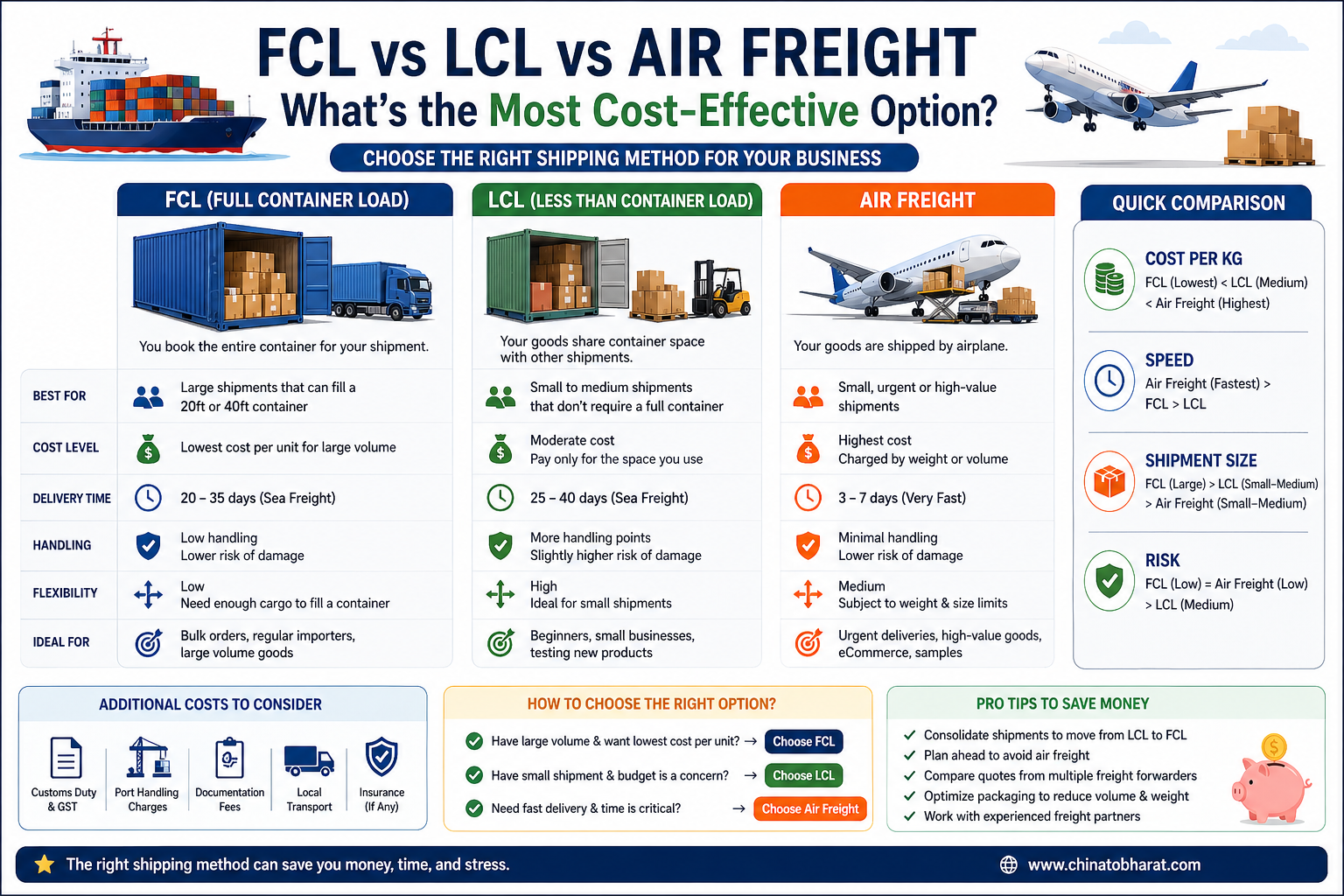
FCL vs LCL vs Air Freight: What’s the Most Cost-Effective Option? (2026 Guide)
When importing goods from China to India, choosing the right shipping method is one of the most important decisions you’ll make. It directly affects your costs, delivery time, and overall profit.
The three most common shipping options are FCL (Full Container Load), LCL (Less than Container Load), and Air Freight. Each comes with its own advantages, limitations, and ideal use cases.
In this guide, you’ll clearly understand how each method works, how much it costs, and which option is the most cost-effective for your business.
🚚 What Are FCL, LCL, and Air Freight?
Before comparing costs, let’s understand what each method means.
🚢 FCL (Full Container Load)
FCL means you book an entire shipping container for your goods. You don’t share the container with anyone else.
Containers usually come in:
- 20-foot container
- 40-foot container
👉 Even if your goods don’t fully fill the container, you still pay for the full space.
📦 LCL (Less than Container Load)
LCL means your shipment shares container space with other importers.
👉 You only pay for the space your cargo occupies.
This is commonly used by small businesses or beginners who don’t have enough goods to fill a full container.
✈️ Air Freight
Air freight involves transporting goods by airplane.
👉 It is the fastest shipping method but also the most expensive.
Air freight pricing is based on:
- Weight
- Volume (whichever is higher)
💰 Cost Breakdown: FCL vs LCL vs Air Freight
Understanding cost is key to choosing the right method.
🚢 FCL – Best for Bulk Savings
Cost Structure:
- Fixed container cost
- Lower cost per kg for large shipments
✅ Advantages:
- Cheapest per unit for bulk shipments
- Less handling → reduced damage risk
- Faster loading/unloading compared to LCL
❌ Disadvantages:
- High upfront investment
- Not suitable for small shipments
👉 Example:
If you import large quantities regularly, FCL will significantly reduce your cost per product.
📦 LCL – Flexible but Slightly Costly
Cost Structure:
- Charged per cubic meter (CBM)
- Additional consolidation charges
✅ Advantages:
- Pay only for the space you use
- Ideal for small shipments
- Lower initial investment
❌ Disadvantages:
- Higher cost per kg than FCL
- More handling → higher damage risk
- Slight delays due to consolidation
👉 Example:
If you’re importing small quantities, LCL is more practical than paying for a full container.
✈️ Air Freight – Speed Over Cost
Cost Structure:
- Charged per kg (chargeable weight)
- Includes fuel surcharges
✅ Advantages:
- Fastest delivery
- Reliable and predictable
- Minimal handling
❌ Disadvantages:
- Highest cost
- Limited capacity
- Not suitable for heavy or bulky goods
👉 Example:
If you need urgent delivery for high-value goods, air freight is worth the cost.
⚖️ Detailed Comparison Table
| Feature | FCL | LCL | Air Freight |
|---|---|---|---|
| Cost per kg | Lowest | Medium | Highest |
| Delivery Time | 20–35 days | 25–40 days | 3–7 days |
| Shipment Size | Large | Small–Medium | Small–Medium |
| Handling Risk | Low | Medium | Low |
| Flexibility | Low | High | Medium |
📊 Which Option is Most Cost-Effective?
The answer depends on your shipment size, budget, and urgency.
👉 Choose FCL When:
- You have bulk orders
- Your goods can fill a container
- You want the lowest cost per unit
- You import regularly
👉 FCL becomes cheaper than LCL when your shipment is large enough.
👉 Choose LCL When:
- Your shipment is small
- You are just starting your import business
- You want to minimize risk and investment
👉 LCL is perfect for testing products before scaling.
👉 Choose Air Freight When:
- You need fast delivery
- You’re shipping high-value or urgent goods
- Time is more important than cost
👉 Air freight is ideal for eCommerce or seasonal products.
📦 Real-Life Example (Simple Comparison)
Let’s say you’re importing electronics:
- Small order → LCL is cheaper
- Large order → FCL saves money
- Urgent order → Air freight is best
👉 Choosing the wrong method can reduce your profit.
⚠️ Hidden Costs You Must Consider
Many importers focus only on shipping cost, but there are additional charges:
- Customs duty
- GST (IGST)
- Port handling charges
- Documentation fees
- Local transportation
👉 Always calculate your total landed cost.
🛃 Role of Customs Clearance
Your shipment must clear customs in India before delivery.
Handled by the Central Board of Indirect Taxes and Customs.
Customs process includes:
- Document verification
- Duty calculation
- Inspection (if required)
👉 Delays here can affect your delivery timeline and cost.`
💡 Pro Tips to Reduce Shipping Costs
✔ Combine Shipments
Increase volume to switch from LCL to FCL.
✔ Plan Early
Avoid using air freight unless necessary.
✔ Compare Quotes
Always get multiple freight quotes.
✔ Work with Experts
Use reliable freight forwarders.
✔ Optimize Packaging
Reduce volume to lower costs.
📈 How to Choose the Right Option (Simple Formula)
Ask yourself:
- Is my shipment large? → Choose FCL
- Is my shipment small? → Choose LCL
- Do I need it urgently? → Choose Air
👉 This simple approach helps you decide quickly.
🚀 Final Recommendation
For most importers:
- Start with LCL
- Move to FCL as your business grows
- Use Air Freight only for urgent needs
👉 This strategy balances cost and efficiency.
📝 Conclusion
Choosing between FCL, LCL, and air freight is not just about shipping—it’s about maximizing profit and efficiency.
- FCL is the most cost-effective for bulk shipments
- LCL is flexible and beginner-friendly
- Air freight is best for speed and urgency
By understanding these options and planning your shipments wisely, you can reduce costs, avoid delays, and scale your import business successfully.
❓ FAQs
1. Which is the cheapest shipping method?
FCL is the cheapest per unit for large shipments.
2. Is LCL good for beginners?
Yes, it’s ideal for small shipments and low investment.
3. Why is air freight expensive?
Because it offers fast delivery and high reliability.
4. When should I switch from LCL to FCL?
When your shipment volume increases significantly.
5. Which method is safest?
FCL and air freight have lower risk due to less handling.


