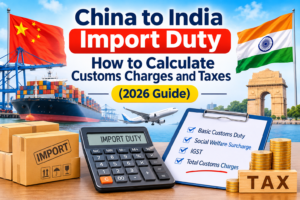
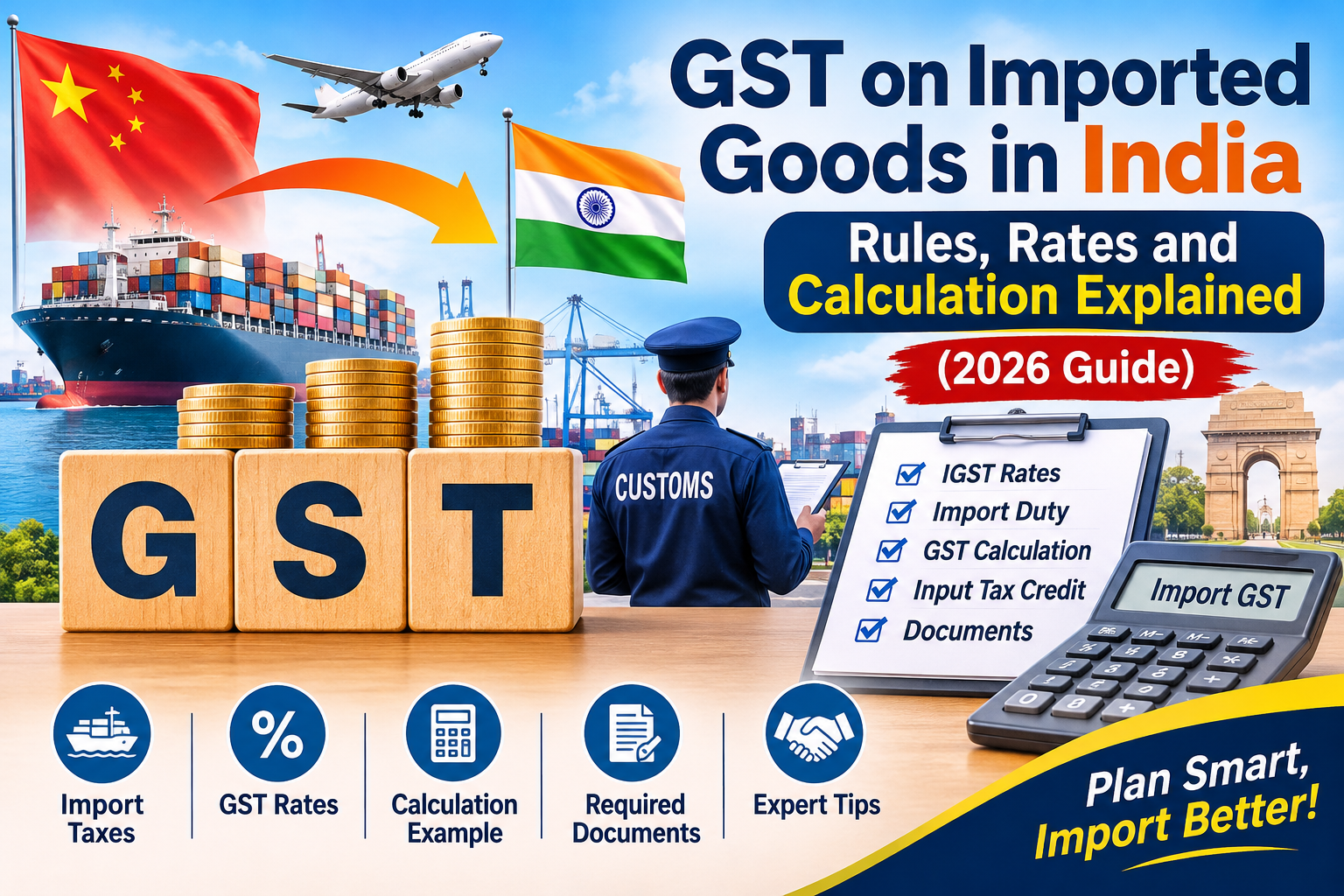
Importing products from China and other international markets can create excellent business opportunities for Indian entrepreneurs. However, understanding GST on imported goods in India is essential before placing orders with overseas suppliers. Importers must consider several taxes, including Integrated Goods and Services Tax (IGST), Basic Customs Duty (BCD), Social Welfare Surcharge (SWS), and other applicable customs duties.
Whether you are importing electronics, machinery, clothing, accessories, home décor, or industrial products, knowing how import GST works can help you calculate the actual landed cost and avoid unexpected expenses.
In this guide, ChinaToBharat explains GST rules, applicable tax rates, customs duty calculations, input tax credit, and important documents required when importing goods into India in 2026.
1. What Is GST on Imported Goods in India?
Goods and Services Tax (GST) is an indirect tax applicable to the supply of goods and services. When products are imported into India from another country, they are generally treated as inter-state supplies under the Integrated Goods and Services Tax Act, 2017.
Therefore, importers must pay IGST in addition to applicable customs duties when clearing goods through Indian customs.
Unlike domestic purchases, where GST is collected by the supplier, IGST on imported goods is generally collected by Indian Customs during the import clearance process.
The main objective is to ensure that imported products receive similar tax treatment to domestically supplied products.
2. Types of Taxes Applicable to Imported Goods
Importing products into India may involve multiple taxes depending on the product category, country of origin, applicable notifications, and customs classification.
Basic Customs Duty (BCD):
BCD is the primary customs duty imposed on imported products. Its rate depends on the product’s classification under the Customs Tariff Act, 1975.
Integrated Goods and Services Tax (IGST):
IGST is charged on imported goods at the applicable GST rate. It is calculated on the assessable value plus applicable customs duties.
Social Welfare Surcharge (SWS):
SWS is generally calculated as a percentage of Basic Customs Duty. The standard rate is 10% of BCD, subject to applicable exemptions.
Compensation Cess and Other Duties:
Certain products may attract additional taxes or duties, including compensation cess, anti-dumping duty, safeguard duty, or Agriculture Infrastructure and Development Cess (AIDC), where applicable.
Understanding these components helps importers estimate the total customs liability before shipping products.
3. What Are the GST Rates on Imported Goods in India in 2026?
The IGST rate applicable to imported products generally follows the notified GST rate for the corresponding goods.
Following the GST rate reforms effective from 22 September 2025, India’s GST structure was streamlined, primarily around 5% and 18%, with a 40% rate applicable to specified luxury and demerit goods. Certain goods also have nil or other specially notified rates.
The applicable IGST rate depends on the product’s HSN classification.
For example:
- Essential goods and selected products may attract 0% or 5% GST.
- Many electronics, appliances, and general commercial products attract 18% GST.
- Specified luxury and demerit products may attract 40% GST.
Importers should not assume that every imported product attracts the same GST rate. Always verify the latest applicable rate using the official CBIC GST rate notifications.
4. How to Calculate GST on Imported Goods in India
Calculating import GST correctly is important for determining the actual cost of purchasing products from overseas suppliers.
The IGST calculation generally involves the following steps:
Step 1: Determine the Assessable Value
Customs assessable value is generally based on the transaction value, adjusted according to customs valuation rules. It normally includes the product price, international freight, insurance, and other applicable additions.
Step 2: Calculate Basic Customs Duty
Multiply the assessable value by the applicable BCD rate.
Step 3: Calculate Social Welfare Surcharge
Calculate SWS on the applicable BCD amount, subject to exemptions.
Step 4: Calculate IGST
IGST is generally calculated on the assessable value plus applicable customs duties and other includible amounts.
Example of Import GST Calculation:
Suppose an Indian business imports products with an assessable value of ₹1,00,000.
Assume the following illustrative rates:
- Assessable Value: ₹1,00,000
- Basic Customs Duty: 10%
- Social Welfare Surcharge: 10% of BCD
- IGST: 18%
Calculation:
| Particulars | Amount |
|---|---|
| Assessable Value | ₹1,00,000 |
| Basic Customs Duty (10%) | ₹10,000 |
| SWS (10% of BCD) | ₹1,000 |
| IGST Taxable Value | ₹1,11,000 |
| IGST (18%) | ₹19,980 |
| Total Import Taxes | ₹30,980 |
Therefore, the total customs taxes in this example are ₹30,980, excluding any other applicable duties, charges, and logistics expenses.
The total product value after these taxes becomes ₹1,30,980.
This is an illustrative calculation, not a universal import duty rate. Actual liability depends on the product classification and applicable customs notifications.
5. Can Businesses Claim Input Tax Credit on Import GST?
One important advantage for GST-registered businesses is the availability of Input Tax Credit (ITC) on eligible IGST paid during imports.
If you import products for business purposes and use them for making taxable or eligible zero-rated supplies, you may claim ITC of the IGST paid at customs, subject to GST rules.
To claim ITC, businesses should:
- Have a valid GST registration.
- Possess the relevant Bill of Entry.
- Ensure the import is made for eligible business purposes.
- Maintain proper accounting and import documentation.
- Meet the applicable conditions under the CGST Act.
However, Basic Customs Duty and Social Welfare Surcharge are generally not available as GST input tax credit.
Claiming eligible import IGST as ITC can help reduce the overall GST liability when selling imported products in India.
6. Documents Required for Importing Goods into India
Proper documentation is essential for smooth customs clearance and GST compliance.
Common documents include:
- Import Export Code (IEC).
- GST Registration Certificate, where applicable.
- Commercial Invoice from the overseas supplier.
- Packing List.
- Bill of Lading or Airway Bill.
- Bill of Entry.
- Certificate of Origin, where required.
- Insurance and freight documents.
- Product-specific licences or regulatory approvals, where applicable.
For imports from China, maintaining accurate supplier invoices, product descriptions, HSN codes, and shipping details is particularly important.
7. Common Mistakes to Avoid When Paying GST on Imports
Many first-time importers underestimate their total import expenses because they focus only on the product purchase price.
Here are some common mistakes to avoid:
- Calculating GST without considering applicable customs duties.
- Using an incorrect HSN code.
- Ignoring international freight and insurance in customs valuation.
- Assuming all products attract an 18% IGST rate.
- Forgetting additional duties or product-specific restrictions.
- Submitting incomplete customs documentation.
- Failing to maintain Bill of Entry records for ITC claims.
Working with an experienced import and logistics partner can help businesses reduce documentation errors and manage customs clearance more efficiently.
8. How ChinaToBharat Helps Businesses Import Products from China
Importing products from China involves several stages, including supplier coordination, product sourcing, international transportation, customs documentation, and delivery in India.
ChinaToBharat helps businesses navigate the China-to-India import process with sourcing and logistics support.
Whether you are a startup, wholesaler, retailer, or established business, having the right import partner can simplify international trade operations.
With proper planning, accurate customs documentation, and an understanding of import taxes, businesses can manage shipping costs and make better purchasing decisions.
Explore ChinaToBharat to learn more about China-to-India sourcing, shipping, and import solutions.
Frequently Asked Questions (FAQs)
1. Is GST applicable to imported goods in India?
Yes. Imported goods are generally subject to IGST in addition to applicable customs duties, unless a specific exemption or concessional notification applies.
2. What is the IGST rate on imported goods in India?
The IGST rate depends on the product’s HSN classification. Different products may attract nil, 5%, 18%, 40%, or other specifically notified rates.
3. How is GST calculated on imported products?
IGST is generally calculated on the assessable value of imported goods plus applicable customs duties and other includible amounts.
4. Can I claim GST input credit on imported goods?
Yes. Eligible GST-registered businesses can generally claim ITC on IGST paid during imports, subject to applicable conditions and documentation requirements.
5. Is Basic Customs Duty eligible for Input Tax Credit?
No. Basic Customs Duty is not eligible for GST input tax credit.
6. Do I need GST registration to import products from China?
GST registration is not universally mandatory merely because a person imports goods. However, businesses making taxable supplies must evaluate applicable GST registration requirements and other import-related compliance obligations.
7. What is the most important document for claiming import GST credit?
The Bill of Entry is the key document supporting an eligible ITC claim for IGST paid on imported goods.
Conclusion
Understanding GST on imported goods in India is essential for businesses planning to source products from China or other international markets. From IGST and Basic Customs Duty to input tax credit and customs documentation, every component plays an important role in calculating the final landed cost.
Before placing an international order, verify the applicable HSN code, customs duty, IGST rate, and product-specific import requirements. Proper planning can help avoid unexpected expenses, improve cost management, and make your import business more profitable.
Planning to import products from China to India? Connect with ChinaToBharat and make your international sourcing and shipping journey easier.