



About Us
China to Bharat is the only professional group of companies who can be your import export agents from China to India imports for full or loose container cargo load.
Gallery
Social Account



How to Find Reliable Suppliers in China: Complete Guide for Indian Importers (2026) 🚢📦
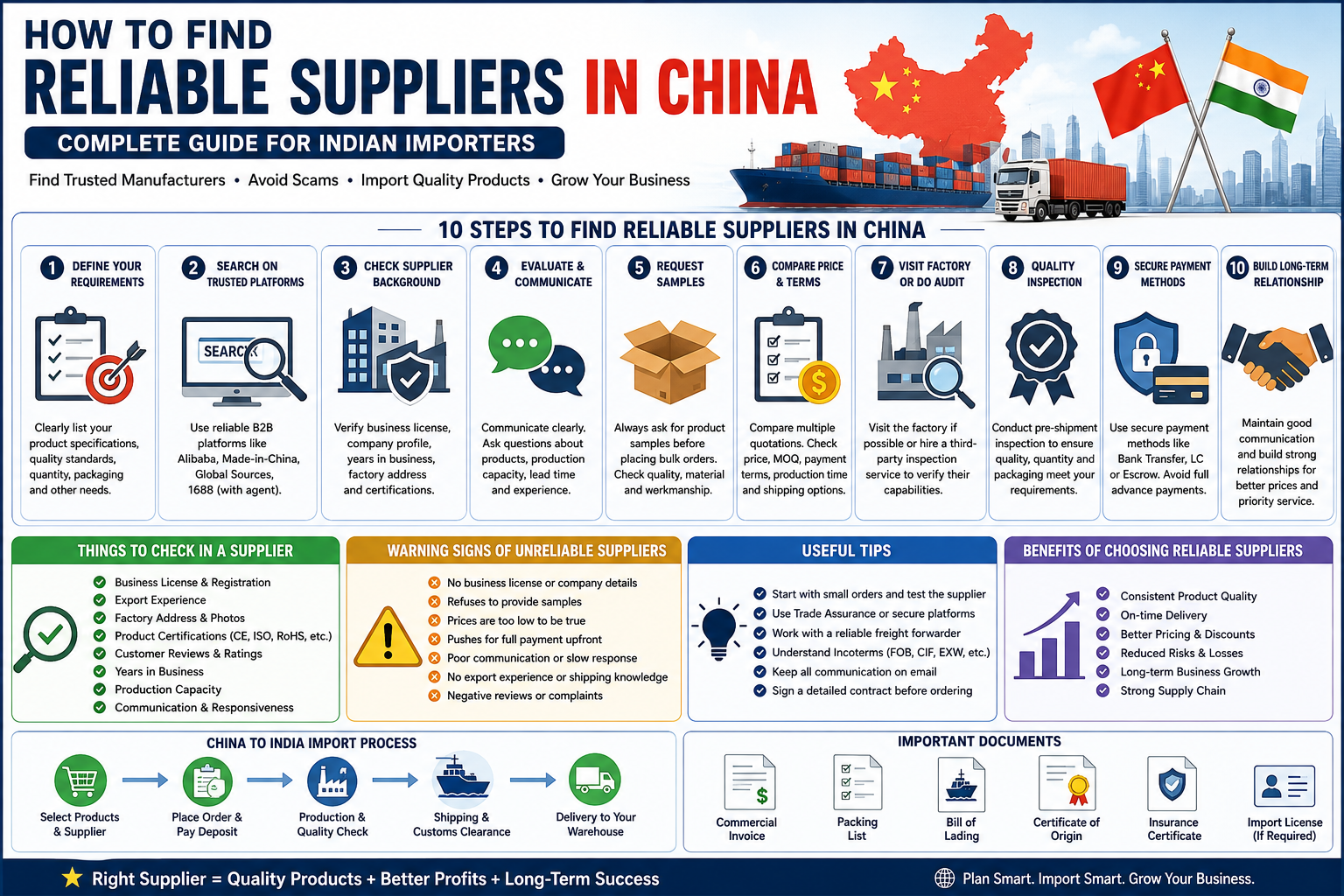
How to Find Reliable Suppliers in China: Complete Guide for Indian Importers (2026)
China remains one of the world’s largest manufacturing hubs, supplying products to businesses across the globe. For Indian importers, sourcing products from China offers opportunities to access competitive prices, a wide range of products, and advanced manufacturing capabilities.
However, one of the biggest challenges for new importers is finding reliable suppliers. Choosing the wrong supplier can lead to poor product quality, delayed shipments, financial losses, and even fraud.
This guide explains how to find trustworthy suppliers in China and build successful long-term business relationships.
Why Choosing the Right Supplier Matters
A reliable supplier can help your business by providing:
- High-quality products
- Competitive pricing
- On-time deliveries
- Consistent production
- Better communication
- Long-term business growth
On the other hand, an unreliable supplier may cause shipment delays, defective products, and unexpected costs.
Define Your Product Requirements
Before searching for suppliers, clearly identify your needs.
Prepare a detailed list including:
- Product specifications
- Materials
- Dimensions
- Packaging requirements
- Quantity
- Quality standards
- Custom branding requirements
Clear requirements help suppliers provide accurate quotations.
Research the Chinese Market
Understanding the market helps you identify the best sourcing options.
Research:
- Product trends
- Manufacturing regions
- Average pricing
- Competitor products
- Industry standards
Different regions in China specialize in different products.
Use Trusted B2B Platforms
Online B2B marketplaces are among the most popular ways to find suppliers.
Look for suppliers with:
- Verified business profiles
- Good customer reviews
- Multiple years of operation
- Trade assurance programs
- Export experience
Always compare several suppliers before making a decision.
Check Company Background
A professional supplier should have:
- Business registration
- Export license
- Manufacturing capabilities
- Company website
- Factory information
Verify whether the company is a manufacturer or a trading company.
Verify Business Experience
Experienced suppliers often provide:
- Better quality control
- Stable production capacity
- Professional export services
- Faster communication
Ask how long they have been exporting products internationally.
Request Product Samples
Never place a large order without testing samples.
Evaluate:
- Product quality
- Material standards
- Packaging
- Workmanship
- Functionality
Sample testing helps reduce business risks.
Compare Multiple Quotations
Do not select a supplier based only on the lowest price.
Compare:
- Product cost
- Shipping options
- Production time
- Payment terms
- Quality standards
Extremely low prices can sometimes indicate poor quality.
Check Factory Production Capacity
Ask questions such as:
- Monthly production volume
- Number of employees
- Manufacturing equipment
- Quality control process
Large orders require suppliers with sufficient production capacity.
Understand Payment Terms
Common payment methods include:
- Bank transfer
- Letter of Credit
- Secure payment platforms
Avoid paying the full amount in advance to unknown suppliers.
Many importers use a deposit system, with the balance paid after production or inspection.
Conduct Quality Inspections
Quality inspections help ensure products meet agreed standards.
Inspection may include:
- Product dimensions
- Material quality
- Packaging
- Quantity verification
- Functional testing
Independent inspections reduce the risk of receiving defective products.
Verify Export Experience
Suppliers familiar with international trade understand:
- Shipping documentation
- Customs procedures
- Packaging standards
- International logistics
Export experience often leads to smoother transactions.
Check Communication Quality
Good communication is a sign of a professional supplier.
Reliable suppliers usually:
- Respond quickly
- Answer technical questions
- Provide clear quotations
- Share production updates
Poor communication can lead to misunderstandings.
Visit the Factory (If Possible)
For large orders, visiting the factory can be beneficial.
A factory visit helps you verify:
- Production facilities
- Employee strength
- Manufacturing process
- Quality control systems
If visiting is not possible, consider hiring a local inspection agency.
Protect Your Business with Contracts
A written agreement should include:
- Product specifications
- Pricing
- Delivery schedule
- Payment terms
- Quality standards
- Warranty conditions
Clear contracts help prevent disputes.
Common Mistakes to Avoid
Choosing the Cheapest Supplier
Low prices do not always mean better value.
Skipping Sample Orders
Testing products before bulk orders is essential.
Ignoring Quality Checks
Quality problems can damage your business reputation.
Paying Full Amount Upfront
Use secure payment structures.
Not Verifying Company Details
Always perform background checks.
Warning Signs of an Unreliable Supplier
Be cautious if a supplier:
- Refuses to provide company information
- Avoids sample requests
- Offers unrealistic prices
- Pressures for immediate payment
- Has poor communication
- Cannot provide export references
Recognizing these warning signs can prevent costly mistakes.
Build Long-Term Supplier Relationships
Successful import businesses often work with the same suppliers for many years.
Strong relationships can provide:
- Better prices
- Priority production
- Flexible payment terms
- Improved quality control
- Faster order processing
Trust and consistent communication benefit both parties.
Role of Freight Forwarders
Freight forwarders can help coordinate:
- Cargo collection
- Shipping arrangements
- Customs documentation
- Import procedures
- Final delivery
Working with experienced logistics partners simplifies the import process.
Future of Supplier Sourcing in 2026
Technology is making supplier selection easier.
Modern businesses use:
- AI-powered supplier analysis
- Digital quality inspections
- Online factory audits
- Real-time shipment tracking
- Automated supply chain management
Digital transformation is improving transparency and reducing sourcing risks.
Conclusion
Finding reliable suppliers in China is one of the most important steps for building a successful import business. Careful research, product testing, background verification, and proper communication can help businesses avoid fraud and ensure consistent product quality.
By selecting trustworthy suppliers and maintaining strong business relationships, Indian importers can reduce risks, improve profitability, and build a sustainable import business for the future.
Frequently Asked Questions
1. How can I find reliable suppliers in China?
Use trusted B2B platforms, verify company details, request samples, and compare multiple suppliers.
2. Should I order samples before bulk purchasing?
Yes. Product samples help verify quality and reduce business risks.
3. How can I avoid supplier fraud?
Check company registration, verify export experience, use secure payment methods, and conduct quality inspections.
4. Why is communication important when selecting suppliers?
Clear communication helps prevent misunderstandings and ensures smooth business operations.
5. What should I check before placing a large order?
Review product quality, production capacity, payment terms, contracts, and shipping arrangements.


