



About Us
China to Bharat is the only professional group of companies who can be your import export agents from China to India imports for full or loose container cargo load.
Gallery
Social Account



How to Import Products from China to India in 2026: Complete Step-by-Step Guide for Beginners
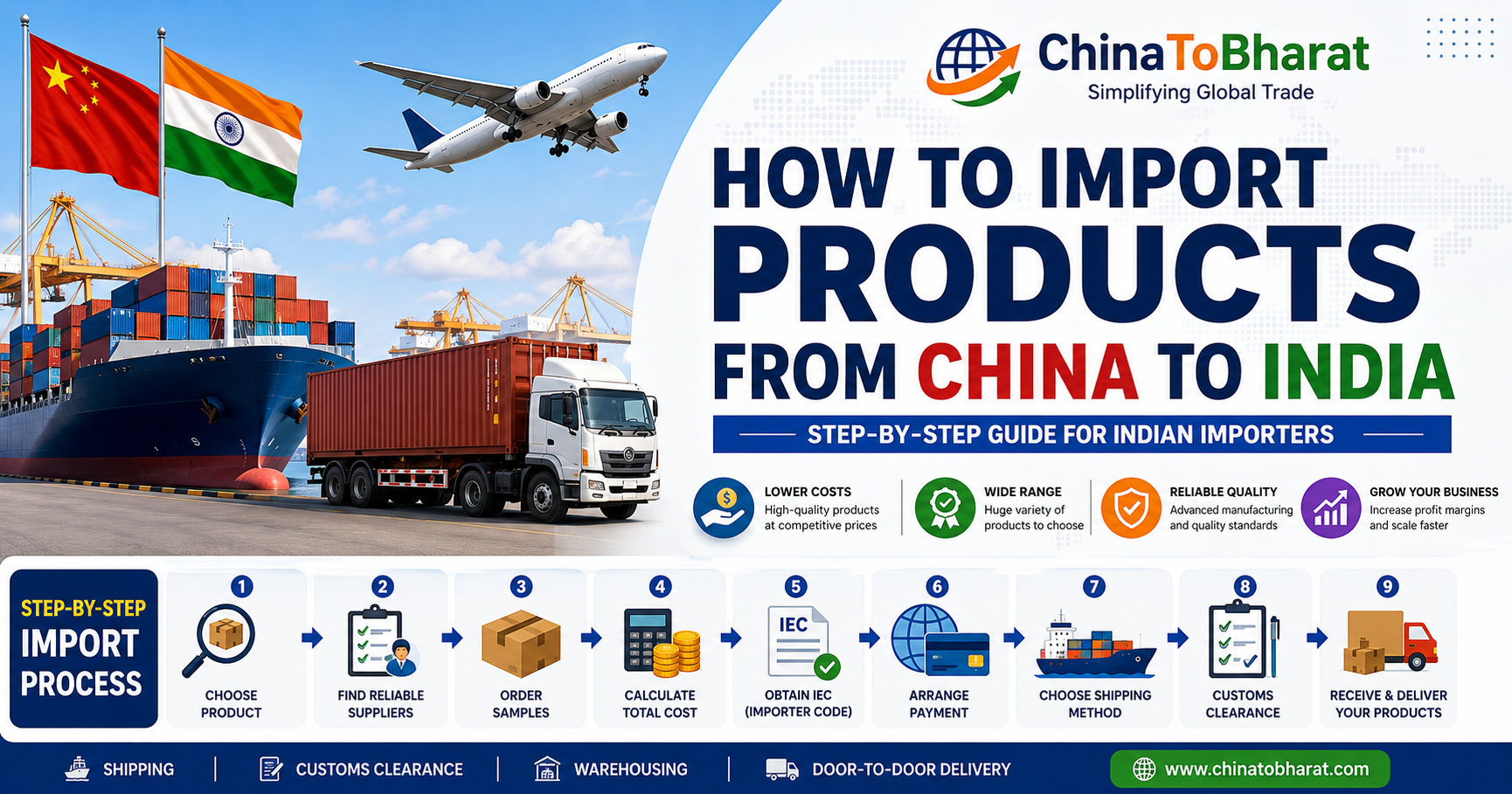
How to Import Products from China to India (Step-by-Step Guide 2026)
Importing products from China to India has become one of the most profitable business opportunities for entrepreneurs, wholesalers, retailers, and eCommerce sellers. China is known for its vast manufacturing capabilities, competitive pricing, and extensive product range, making it a preferred sourcing destination for Indian businesses.
However, importing products involves more than simply placing an order with a supplier. Understanding supplier selection, documentation, shipping methods, customs clearance, duties, and logistics is essential for a successful import business.
This comprehensive guide explains the complete process of importing products from China to India step-by-step.
🌏 Why Import Products from China?
China remains the world’s manufacturing hub due to:
- Competitive product pricing
- Large-scale manufacturing capacity
- Wide product variety
- Advanced production facilities
- Customization options
- Reliable supply chains
Indian businesses import a wide range of products including:
- Electronics
- Mobile accessories
- Home products
- Machinery
- Fashion accessories
- Toys
- Industrial equipment
- Fitness products
📋 Step 1: Choose the Right Product
The first step is identifying products with strong demand and healthy profit margins.
When selecting products, consider:
Market Demand
Research products that customers actively search for and buy.
Competition
Analyze existing competitors and pricing.
Shipping Costs
Choose products that are economical to transport.
Profit Margins
Calculate potential profits after all expenses.
Import Regulations
Verify whether the product requires certifications or approvals.
Popular import categories include:
- Mobile accessories
- LED lighting
- Home and kitchen products
- Beauty products
- Smart gadgets
- Fitness equipment
🔍 Step 2: Find Reliable Suppliers
Finding trustworthy suppliers is critical.
Many importers source products through Alibaba.
When evaluating suppliers:
Check Company Profile
Review years in business and export experience.
Verify Certifications
Request business licenses and product certifications.
Review Customer Feedback
Analyze ratings and reviews.
Communicate Directly
Discuss product specifications and production capabilities.
Request Samples
Always inspect samples before placing large orders.
📦 Step 3: Order Product Samples
Never place a bulk order without testing samples.
Inspect:
- Product quality
- Packaging quality
- Product functionality
- Material standards
- Branding accuracy
Sample orders help prevent costly mistakes.
💰 Step 4: Calculate Total Landed Cost
Many beginners calculate only product cost and ignore additional expenses.
Your total landed cost includes:
- Product cost
- Shipping charges
- Customs duty
- GST
- Port charges
- Freight forwarding fees
- Local transportation
Formula:
Selling Price – Total Landed Cost = Profit
Proper calculations ensure profitable importing.
📄 Step 5: Obtain an Importer Exporter Code (IEC)
To import legally into India, businesses need an IEC.
The IEC is issued by the Directorate General of Foreign Trade.
Why IEC is important:
- Mandatory for imports
- Required during customs clearance
- Needed for international payments
Without an IEC, commercial imports cannot proceed.
🏢 Step 6: Register Your Business
Importers usually operate through:
- Sole Proprietorship
- Partnership
- LLP
- Private Limited Company
Business registration improves credibility and compliance.
💳 Step 7: Arrange International Payment
Common payment methods include:
Bank Transfer (T/T)
Widely used for international transactions.
Letter of Credit (LC)
Offers added security for large orders.
Platform Payment Systems
Some sourcing platforms provide payment protection.
Always clarify payment terms before production begins.
🚢 Step 8: Choose the Right Shipping Method
Selecting the correct shipping method affects cost and delivery speed.
Sea Freight
Best for:
- Large shipments
- Bulk orders
Transit time:
20–40 days
Benefits:
- Lowest shipping cost
Air Freight
Best for:
- Urgent shipments
- High-value products
Transit time:
3–7 days
Benefits:
- Faster delivery
Courier Services
Suitable for:
- Samples
- Small orders
Popular providers include:
- DHL
- FedEx
- UPS
Transit time:
5–10 days
🚛 Step 9: Work with a Freight Forwarder
Freight forwarders simplify international shipping.
A logistics partner such as ChinaToBharat can assist with:
- Cargo pickup
- Shipping arrangements
- Documentation
- Customs clearance
- Final delivery
This reduces operational complexity.
📑 Step 10: Prepare Import Documents
Proper documentation is essential.
Common documents include:
Commercial Invoice
Shows product value and transaction details.
Packing List
Contains packaging and quantity information.
Bill of Lading
Proof of cargo shipment.
IEC Certificate
Importer identification document.
GST Registration
Required for tax compliance.
Insurance Certificate
Optional but recommended.
🛃 Step 11: Customs Clearance Process
When cargo reaches India, it must clear customs.
The process is managed by the Central Board of Indirect Taxes and Customs.
Steps include:
- Filing Bill of Entry
- Document verification
- Duty assessment
- Inspection (if required)
- Clearance approval
Incomplete documentation can cause delays.
💸 Step 12: Pay Import Duty and GST
Import taxes vary by product category.
Charges depend on:
- HS Code
- Product value
- Applicable duty rates
- GST rates
Proper classification helps avoid penalties.
📦 Step 13: Receive and Inspect Cargo
After customs clearance:
- Goods are released
- Cargo is transported to your warehouse
- Products are inspected
Verify:
- Quantity
- Packaging condition
- Product quality
Report discrepancies immediately.
📈 Step 14: Sell and Scale
Once inventory arrives:
- Launch sales channels
- Monitor customer feedback
- Analyze performance
- Reorder successful products
Many successful importers start small and scale gradually.
⚠️ Common Importing Mistakes to Avoid
Choosing Suppliers Based Only on Price
Low prices can mean poor quality.
Skipping Product Samples
Always verify products before bulk orders.
Ignoring Total Costs
Calculate full landed costs.
Incorrect Documentation
Errors can delay customs clearance.
Not Understanding Duties
Estimate taxes beforehand.
Ordering Too Much Inventory
Start with manageable quantities.
🚀 Tips for Successful Importing
Research Products Thoroughly
Validate demand before purchasing.
Build Supplier Relationships
Long-term partnerships improve pricing and service.
Use Cargo Insurance
Protect shipments from unexpected risks.
Track Shipments
Monitor cargo throughout transit.
Partner with Experienced Logistics Providers
Professional support reduces complications.
📊 Example Import Scenario
Suppose you import mobile accessories from China.
Process:
- Research demand
- Find supplier
- Order samples
- Place bulk order
- Arrange sea freight
- Complete customs clearance
- Receive inventory
- Sell products online
Following a structured process improves success rates.
📝 Conclusion
Importing products from China to India can be highly profitable when approached strategically. Understanding sourcing, supplier verification, shipping, customs clearance, duties, and logistics is essential for minimizing risks and maximizing profits.
By following this step-by-step guide, first-time and experienced importers can build a reliable importing process and take advantage of the opportunities offered by international trade.
❓ Frequently Asked Questions
Do I need an IEC to import from China?
Yes, an IEC is generally required for commercial imports into India.
What is the cheapest shipping method?
Sea freight is usually the most cost-effective option for bulk shipments.
How long does shipping from China to India take?
Sea freight typically takes 20–40 days, while air freight usually takes 3–7 days.
Can I import small quantities from China?
Yes. Many businesses start with small orders or sample shipments.
What is the biggest mistake new importers make?
Failing to calculate total landed costs and choosing suppliers based solely on price.


