



About Us
China to Bharat is the only professional group of companies who can be your import export agents from China to India imports for full or loose container cargo load.
Gallery
Social Account



Import Duty & GST Calculation in India (2026): Complete Guide to Customs Duty & Landed Cost
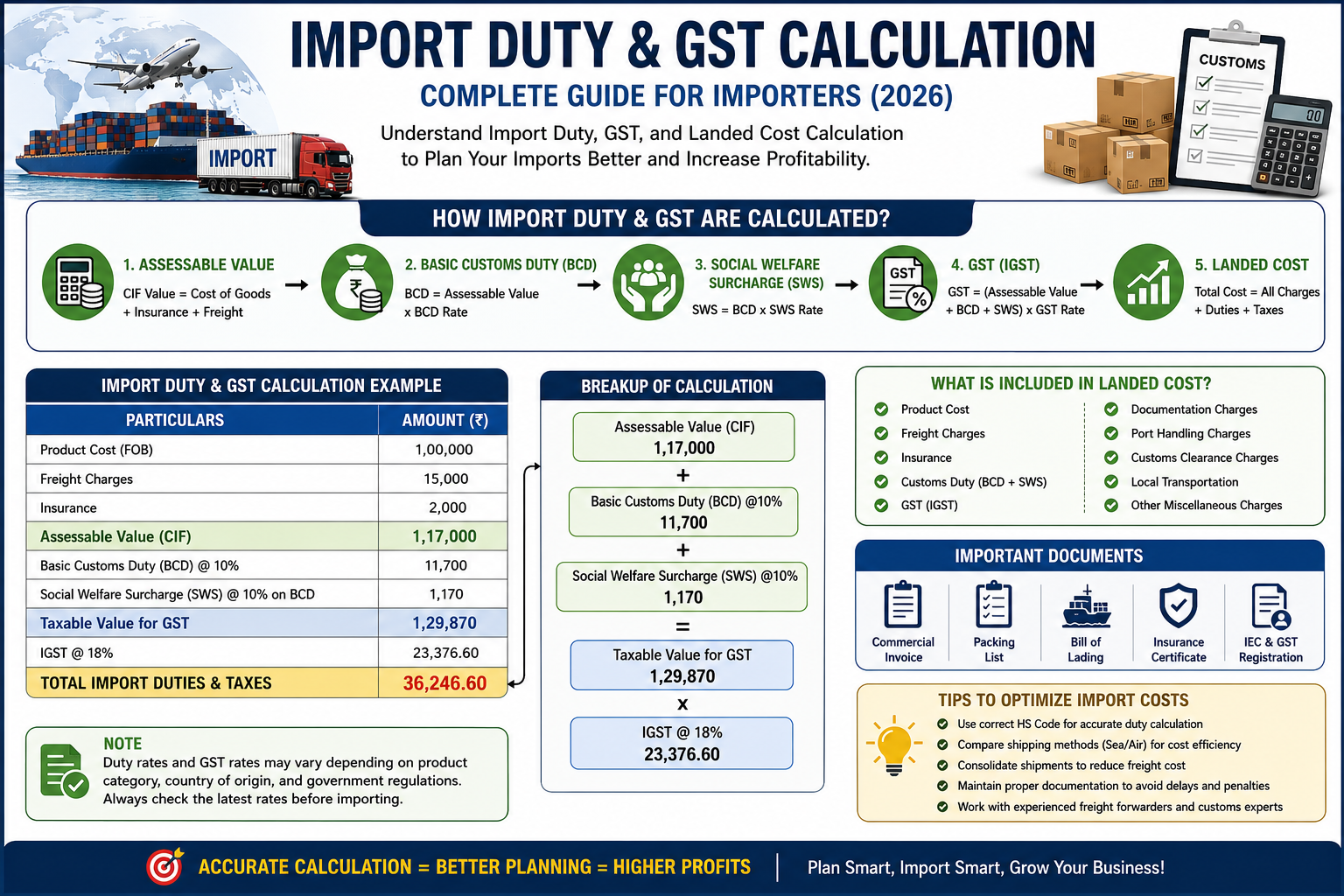
Import Duty & GST Calculation: Complete Guide for Importers (2026)
Importing products from international markets, especially China, has become a profitable business opportunity for Indian entrepreneurs, wholesalers, retailers, and eCommerce sellers. However, one of the most important aspects of importing is understanding how import duty and GST are calculated.
Many new importers consider only the product price and shipping charges when placing an order. In reality, customs duties, GST, insurance, freight charges, and other expenses significantly affect the final landed cost of imported goods.
Knowing how import taxes work helps businesses avoid unexpected costs, plan their budgets, and maintain healthy profit margins.
This guide explains the complete import duty and GST calculation process simply and practically.
What is Import Duty?
Import duty is a tax charged by the Indian government on products imported from other countries. It is collected during customs clearance before the goods are released for delivery.
The objectives of import duty are:
- Protect domestic industries
- Regulate international trade
- Generate government revenue
- Promote fair market competition
Different products attract different duty rates depending on their classification.
Why is Import Duty Important?
Understanding import duty helps businesses:
- Calculate actual product costs
- Estimate profit margins
- Plan import budgets
- Avoid customs surprises
- Improve pricing strategies
Without proper calculations, importers may face unexpected expenses that reduce profitability.
What is GST on Imports?
Imported products are generally subject to Integrated Goods and Services Tax (IGST).
GST applies to imported goods just as it does to products sold within India.
The purpose of GST is to create a unified taxation system and maintain tax fairness between imported and domestic goods.
Understanding HS Codes
Every imported product is classified under an HS Code (Harmonized System Code).
HS Codes determine:
- Import duty rates
- GST rates
- Product classification
- Customs regulations
Examples include:
- Electronics
- Machinery
- Mobile accessories
- Textiles
- Furniture
- Industrial equipment
Using the wrong HS Code may result in:
- Higher duties
- Customs delays
- Penalties
- Additional inspections
Therefore, proper product classification is extremely important.
Understanding Assessable Value
The first step in import duty calculation is determining the assessable value.
The assessable value is usually based on the CIF method.
CIF stands for:
- Cost
- Insurance
- Freight
Formula
Assessable Value = Cost + Insurance + Freight
Example
Product Cost = ₹1,00,000
Insurance = ₹2,000
Freight Charges = ₹15,000
Assessable Value = ₹1,17,000
This value serves as the basis for customs calculations.
Basic Customs Duty (BCD)
Basic Customs Duty is one of the main taxes charged on imports.
Formula
BCD = Assessable Value × Applicable Duty Rate
Example
Assessable Value = ₹1,17,000
BCD Rate = 10%
BCD = ₹11,700
Different products have different BCD rates.
Social Welfare Surcharge (SWS)
A Social Welfare Surcharge may also be applied.
It is generally calculated as a percentage of Basic Customs Duty.
Example
BCD = ₹11,700
SWS Rate = 10%
SWS = ₹1,170
GST Calculation on Imports
GST is calculated after adding customs duties.
Formula
GST Base Value =
Assessable Value + BCD + SWS
Example
Assessable Value = ₹1,17,000
BCD = ₹11,700
SWS = ₹1,170
GST Base Value = ₹1,29,870
If IGST Rate = 18%
IGST = ₹23,376.60
Complete Import Duty Example
Suppose you import products from China.
| Expense | Amount |
|---|---|
| Product Cost | ₹1,00,000 |
| Freight | ₹15,000 |
| Insurance | ₹2,000 |
| Assessable Value | ₹1,17,000 |
| Basic Customs Duty | ₹11,700 |
| Social Welfare Surcharge | ₹1,170 |
| GST Base Value | ₹1,29,870 |
| IGST | ₹23,376.60 |
Total Import Taxes
₹36,246.60
This amount is added to your import expenses.
What is Landed Cost?
Landed cost refers to the total cost of bringing imported products to your warehouse.
It includes:
- Product cost
- Freight charges
- Insurance
- Customs duty
- GST
- Documentation charges
- Port handling charges
- Local transportation
- Cargo insurance
Understanding landed cost helps businesses set accurate selling prices.
Additional Costs Importers Should Consider
Many importers forget hidden expenses.
Some common additional costs include:
Documentation Fees
Preparation of shipping documents.
Port Handling Charges
Terminal and warehouse handling fees.
Customs Broker Charges
Professional customs assistance.
Inland Transportation
Moving cargo from the port to the warehouse.
Bank Charges
International transaction fees.
Currency Conversion Costs
Exchange rate fluctuations.
Documents Required for Import Duty Assessment
Proper documentation speeds up customs clearance.
Common documents include:
Commercial Invoice
Shows product value and transaction details.
Packing List
Contains shipment details and package information.
Bill of Lading
Proof that goods have been shipped.
Air Waybill
Used for air freight shipments.
IEC Certificate
Importer Exporter Code.
GST Registration
Required for tax compliance.
Insurance Certificate
Proof of cargo insurance.
Purchase Order
Commercial agreement between buyer and supplier.
Common Mistakes in Import Duty Calculation
Using Wrong HS Codes
Incorrect classification can increase taxes.
Under-Valuing Goods
False declarations may attract penalties.
Ignoring Freight Costs
Freight forms part of the assessable value.
Not Calculating GST
Many beginners forget GST calculations.
Missing Documentation
Incomplete paperwork delays customs clearance.
Ignoring Hidden Costs
Additional fees affect profitability.
Tips to Reduce Import Costs Legally
Use Correct HS Codes
Proper classification prevents overpayment.
Consolidate Shipments
Shipping larger quantities reduces costs.
Choose the Right Shipping Method
Sea freight is often cheaper for bulk cargo.
Plan Orders Early
Avoid expensive urgent shipments.
Maintain Proper Documentation
Reduces customs delays.
Work with Professional Logistics Providers
Experienced freight forwarders help optimize costs.
Why Accurate Duty Calculation is Important
Proper import tax planning helps businesses:
- Improve pricing
- Increase profits
- Avoid penalties
- Speed up customs clearance
- Manage inventory effectively
- Build long-term business growth
Successful importers always calculate the total landed cost before placing orders.
Example Business Scenario
A retailer imports home appliances from China.
Product Value
₹2,00,000
Freight
₹25,000
Insurance
₹3,000
Import Taxes
₹60,000
Documentation
₹7,000
Local Transport
₹10,000
Total Landed Cost
₹3,05,000
If the retailer ignores import taxes, profits may be significantly lower than expected.
Future of Import Tax Planning
As global trade grows, importers are increasingly using:
- Digital customs systems
- Automated tax calculations
- AI-powered logistics software
- Online shipment tracking
- Smart supply chain management
Technology helps businesses improve accuracy and reduce costs.
Conclusion
Understanding import duty and GST calculation is essential for every importer. Taxes, freight charges, insurance, customs duties, and documentation all contribute to the total landed cost of imported products.
Businesses that calculate import costs correctly can price products more effectively, avoid customs problems, and improve profitability.
Whether you are importing electronics, machinery, consumer goods, or industrial products, proper tax planning and documentation are key to successful international trade.
A well-planned import strategy not only reduces risks but also helps businesses grow in the competitive global marketplace.
Frequently Asked Questions
1. What is import duty?
Import duty is a tax charged on products imported into India.
2. What is assessable value?
It is the value used by customs to calculate import duties and taxes, including cost, insurance, and freight.
3. Is GST applicable to imported goods?
Yes. Imported products are generally subject to Integrated GST (IGST).
4. Why are HS Codes important?
HS Codes determine customs duty rates and import regulations.
5. What is landed cost?
Landed cost is the total cost of importing goods, including shipping, taxes, insurance, and handling charges.
6. How can importers reduce costs legally?
By using correct HS Codes, optimizing shipping methods, consolidating cargo, and maintaining proper documentation.
7. Why should businesses calculate total import costs before ordering?
Proper calculations help estimate profits, avoid unexpected expenses, and improve business planning.


