



About Us
China to Bharat is the only professional group of companies who can be your import export agents from China to India imports for full or loose container cargo load.
Gallery
Social Account



Sea Freight Process from China to India: Step-by-Step Guide for Faster & Cost-Effective Shipping (2026)
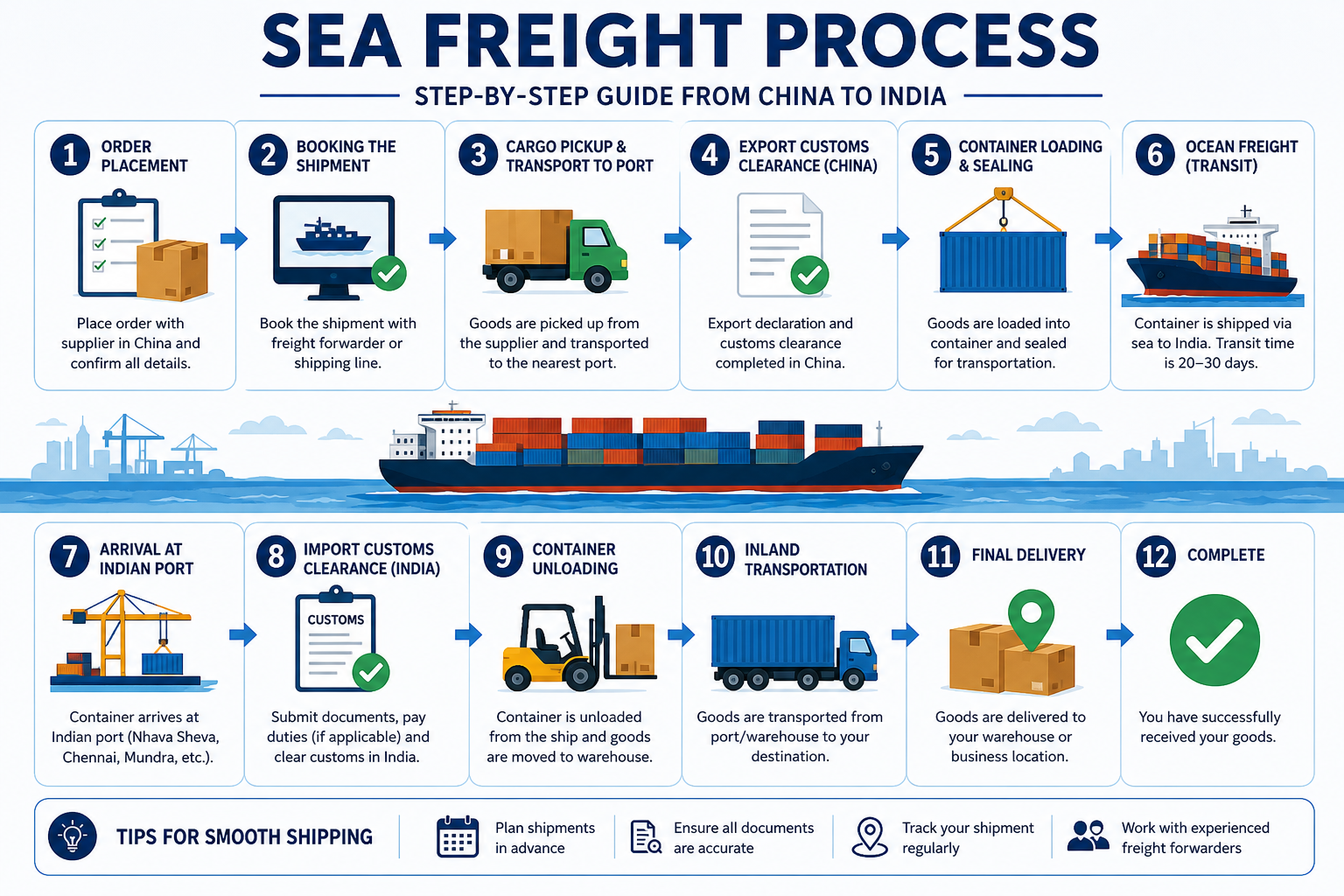
Sea Freight Process Explained (Step-by-Step Guide 2026)
Sea freight is the backbone of global trade and one of the most cost-effective ways to import goods from China to India. If you’re planning to import products in bulk, understanding how sea freight works can save you time, money, and unnecessary stress.
Many beginners assume shipping is just about loading goods onto a ship—but in reality, it involves multiple steps, documentation, coordination, and compliance with regulations.
In this complete guide, you’ll learn the entire sea freight process step-by-step, along with practical tips to ensure smooth shipping.
🚢 What is Sea Freight?
Sea freight refers to transporting goods through cargo ships across international waters. It is widely used for:
- Bulk shipments
- Heavy goods
- Large-volume imports
👉 While slower than air freight, it is significantly cheaper.
📦 Types of Sea Freight
Before diving into the process, it’s important to understand the two main shipping types:
✔ FCL (Full Container Load)
- You book a full container
- Goods are not shared with others
- Faster handling
👉 Best for large shipments and businesses scaling up.
✔ LCL (Less than Container Load)
- You share container space
- Lower cost for small shipments
- Slightly longer handling time
👉 Ideal for small to medium importers.
🔄 Complete Sea Freight Process (Step-by-Step)
Let’s break down the entire journey from China to India:
Step 1: Supplier Finalization & Order Placement
The process begins when you confirm your order with a supplier in China.
Key actions:
- Finalize product specifications
- Confirm pricing and quantity
- Agree on shipping terms (FOB, CIF, EXW)
👉 Clear communication avoids future issues.
Step 2: Choose a Freight Forwarder
A freight forwarder manages your shipment logistics.
👉 Providers like ChinaToBharat help with:
- Booking shipments
- Documentation
- Customs clearance
- Delivery coordination
Step 3: Shipment Booking
Once goods are ready, shipping space is booked with a shipping line.
This includes:
- Selecting container type (FCL/LCL)
- Choosing departure port
- Scheduling shipment
👉 Early booking helps avoid delays.
Step 4: Cargo Pickup from Supplier
Goods are picked up from the factory or warehouse.
Transport includes:
- Trucking to port
- Loading into container (FCL)
- Consolidation (LCL shipments)
👉 Proper packaging is essential at this stage.
Step 5: Export Customs Clearance in China
Before leaving China, goods must pass export customs.
Required:
- Commercial invoice
- Packing list
- Export declaration
👉 Incorrect documents can delay shipment.
Step 6: Container Loading & Sealing
Goods are loaded into containers and sealed.
Important points:
- Proper stacking prevents damage
- Containers are sealed for security
- Verified before shipment
Step 7: Ocean Freight (Transit Phase)
The container is loaded onto a cargo ship and begins its journey to India.
Typical transit time:
- 20–30 days (depending on route)
Common route:
China → Singapore → India
👉 This is the longest phase of the process.
Step 8: Arrival at Indian Port
The shipment arrives at major ports such as:
- Nhava Sheva (Mumbai)
- Chennai
- Mundra
- Kolkata
👉 Port choice affects delivery time and cost.
Step 9: Import Customs Clearance in India
This is a critical step handled by the Central Board of Indirect Taxes and Customs.
Process includes:
- Filing Bill of Entry
- Duty calculation
- Document verification
- Inspection (if required)
👉 Proper documentation ensures faster clearance.
Step 10: Container Unloading
After customs clearance:
- Containers are unloaded
- Goods moved to warehouse or yard
👉 LCL shipments are deconsolidated here.
Step 11: Inland Transportation
Goods are transported from port to final destination.
Options:
- Truck delivery
- Rail transport
👉 Final delivery depends on your location.
Step 12: Final Delivery
Goods are delivered to your:
- Warehouse
- Business location
- Distribution center
👉 This completes the sea freight process.
⏱️ Total Time for Sea Freight
Typical timeline:
- Pickup & export clearance: 3–7 days
- Ocean transit: 20–30 days
- Customs & delivery: 5–10 days
👉 Total: 25–40 days
💰 Cost Factors in Sea Freight
Sea freight costs depend on several factors:
- Container type (FCL/LCL)
- Shipment volume
- Distance and route
- Port charges
- Customs duties
- Inland transport
👉 Sea freight is the cheapest for large shipments.
⚠️ Common Challenges in Sea Freight
Importers may face:
- Port congestion
- Customs delays
- Incorrect documentation
- Weather disruptions
- Container shortages
👉 Planning and proper coordination help avoid these issues.
💡 Tips for Smooth Sea Freight Shipping
✔ Plan Early
Avoid last-minute bookings.
✔ Choose Right Container
Use FCL for bulk, LCL for smaller loads.
✔ Verify Documents
Ensure accuracy in invoices and packing lists.
✔ Work with Experts
Freight forwarders like ChinaToBharat simplify the process.
✔ Track Your Shipment
Use tracking tools for updates.
📊 Example of Sea Freight Flow
Supplier → Pickup → China Port → Export Clearance → Ship → India Port → Import Clearance → Delivery
👉 This is the complete journey.
📈 Why Businesses Prefer Sea Freight
- Lowest cost per unit
- Ideal for scaling imports
- Reliable for large shipments
- Suitable for almost all product types
👉 It’s the most practical choice for growing businesses.
🚀 Advanced Tips for Importers
- Consolidate shipments to save cost
- Negotiate better freight rates
- Choose less congested ports
- Optimize packaging to reduce volume
👉 These strategies increase profitability.
📝 Conclusion
Sea freight is the most efficient and cost-effective method for importing goods from China to India, especially for bulk shipments. While it involves multiple steps, understanding the process helps you avoid delays and manage logistics smoothly.
By planning properly, working with experienced partners, and ensuring correct documentation, you can make your sea freight experience seamless and profitable.
❓ FAQs
1. How long does sea freight take?
Usually 25–40 days depending on route and clearance.
2. What is FCL and LCL?
FCL = Full container, LCL = shared container.
3. Is sea freight safe?
Yes, when properly packed and handled.
4. What is the cheapest shipping method?
Sea freight is the cheapest for bulk shipments.
5. Can beginners use sea freight?
Yes, with the help of a freight forwarder.


