Importing goods from China to India can be a profitable business opportunity for retailers, wholesalers, e-commerce sellers, manufacturers, and entrepreneurs. China offers a huge range of products at competitive prices, but importing successfully requires proper planning, documentation, customs compliance, and logistics management.
If you are wondering how to import goods from China to India in 2026, this step-by-step guide explains the complete process—from finding a supplier in China to receiving your goods in India.
Why Import Goods from China to India?
China is one of the world’s major manufacturing and exporting hubs. Indian businesses commonly source products such as electronics, machinery, home accessories, packaging materials, toys, textiles, hardware, furniture components, and industrial products from Chinese suppliers.
The major advantages include:
- Competitive manufacturing prices
- Large product variety
- OEM and private-label manufacturing options
- Large-scale production capacity
- Customization opportunities
- Established international shipping networks
However, the lowest product price does not always mean the lowest landed cost. You should calculate product cost, freight, insurance, customs duties, taxes, port charges, and other expenses before placing an order.
Step 1: Decide What You Want to Import
The first step is selecting the right product.
Before ordering, research:
- Product demand in India
- Competition and selling prices
- Product quality
- Minimum order quantity (MOQ)
- Shipping costs
- Import restrictions
- Applicable taxes and duties
- Required certifications or approvals
You should also identify the product’s HSN/HS code, because customs classification plays an important role in determining applicable duties and compliance requirements.
ICEGATE provides an official import duty enquiry facility where importers can check tariff information using the tariff heading, product description, and country of origin.
Step 2: Find a Reliable Chinese Supplier
After selecting your product, find reliable suppliers in China.
You can explore manufacturers and exporters through B2B marketplaces, trade exhibitions, sourcing agents, or direct manufacturer relationships.
Before choosing a supplier, check:
- Company history
- Business registration
- Product certifications
- Customer reviews
- Factory capability
- MOQ
- Production time
- Payment terms
- Export experience
Always request product samples before placing a large order. A sample can help you verify quality, packaging, dimensions, materials, and specifications.
Step 3: Negotiate Price and Payment Terms
Once you identify a supplier, negotiate the product price and commercial terms.
Important terms to discuss include:
- Unit price
- Minimum order quantity
- Packaging
- Production timeline
- Payment method
- Shipping terms
- Inspection requirements
- Warranty or replacement policy
Pay close attention to Incoterms, such as EXW, FOB, CIF, and DDP. The selected Incoterm determines which party is responsible for transportation, insurance, customs clearance, and related costs.
For first-time importers, professional freight forwarders and customs brokers can help clarify these responsibilities.
Step 4: Obtain an Import Export Code (IEC)
An Import Export Code (IEC) is generally required for businesses importing goods into India.
The IEC is issued through the Directorate General of Foreign Trade (DGFT). Businesses should ensure that their business, PAN, bank, GST, and other relevant details are correctly maintained.
After obtaining the necessary registrations, importers also need to complete the appropriate customs-related registration and processes.
ICEGATE is India’s customs electronic portal and provides online services for customs documentation, registration, tracking, payments, and other trade-related activities.
Step 5: Calculate the Total Landed Cost
One of the biggest mistakes new importers make is calculating only the supplier’s product price.
Your landed cost may include:
Product Cost + China Inland Transportation + International Freight + Insurance + Customs Duty + IGST + Port/Terminal Charges + Customs Broker Charges + Local Transportation = Landed Cost
For example, if you purchase products for ₹2 lakh, the final cost after freight, customs duties, taxes, handling, and transportation could be considerably higher.
Therefore, calculate the expected landed cost before confirming the purchase order.
Step 6: Arrange International Shipping
You can generally choose between:
Sea Freight
Best for:
- Large shipments
- Heavy goods
- Commercial imports
- Lower transportation cost per unit
Air Freight
Best for:
- Small shipments
- High-value products
- Time-sensitive orders
- Samples
Your freight forwarder can help select the appropriate route, shipping method, port, and documentation.
Step 7: Prepare Import Documents
Correct documentation is essential for smooth customs clearance.
Common documents may include:
- Commercial Invoice
- Packing List
- Bill of Lading or Air Waybill
- Purchase Order
- Certificate of Origin, where applicable
- Insurance documents
- Import-related licenses or certificates, where required
- Bill of Entry
- Other product-specific regulatory documents
The exact requirements depend on the product, classification, country of origin, and applicable Indian regulations.
ICEGATE supports online customs documentation and Bill of Entry processes.
Step 8: Customs Clearance in India
When the shipment reaches India, customs clearance begins.
The importer or authorized customs broker submits the required information and documentation. A Bill of Entry is filed for the imported goods.
Customs may assess:
- Product classification
- Declared value
- Country of origin
- Applicable customs duties
- Import restrictions
- Regulatory requirements
- Required government-agency approvals
Some products may require examination or clearance from specific government agencies.
ICEGATE’s current system includes facilities for customs documentation, Bill of Entry status, online services, and government-agency compliance workflows.
Step 9: Pay Customs Duty and Applicable Taxes
Importers must pay applicable customs duties and taxes before the goods can be cleared, subject to the applicable customs procedure.
The exact amount depends on the product’s classification and current tariff and tax rules.
Do not rely on a generic “China import duty rate.” Import duty varies by product and tariff classification.
Use the official ICEGATE Trade Guide to check the applicable tariff information for your specific product and country of origin.
Step 10: Receive Your Goods
After customs clearance and completion of the required procedures, the shipment can be released for delivery.
Your freight forwarder, customs broker, shipping line, courier, or logistics provider may coordinate the final movement of the goods to your warehouse or business location.
Before accepting the shipment, inspect:
- Quantity
- Packaging
- Product condition
- Damages
- Product specifications
- Labels and markings
If there is a discrepancy, document it immediately and contact the supplier or logistics provider.
Common Mistakes to Avoid When Importing from China
New importers should avoid these common mistakes:
1. Choosing a Supplier Only Because of Low Price
An extremely low quote may indicate poor quality, hidden costs, or unreliable service.
2. Ignoring Import Regulations
Some products may require specific licenses, certifications, testing, labeling, or approvals before they can be legally imported or sold in India.
3. Underestimating Landed Cost
Freight, customs duty, taxes, port charges, and local transportation can significantly affect profitability.
4. Ordering Large Quantities Without a Sample
Always test product quality before committing to a large commercial order.
5. Using Incorrect Product Classification
Incorrect HS/CTH classification can create customs delays, additional costs, or compliance problems.
6. Not Checking Supplier Documents
Verify invoices, packing lists, product specifications, and shipping documents carefully before shipment.
Is Importing from China to India Profitable in 2026?
Yes, importing from China can be profitable when the product has strong demand, competitive landed cost, and sufficient selling margin.
However, profitability depends on more than the supplier’s quoted price. Before importing, calculate your complete landed cost, research the Indian market, verify regulations, and estimate your expected selling price.
Start with a small shipment, validate the market, and gradually increase your order volume once your supplier and logistics process are proven.
Final Thoughts
Learning how to import goods from China to India is much easier when you follow a structured process. From selecting the right product and supplier to obtaining IEC registration, arranging shipping, preparing documents, completing customs clearance, and calculating landed costs, every step matters.
For a successful China-to-India import business in 2026, focus on supplier verification, accurate documentation, correct product classification, regulatory compliance, reliable logistics, and realistic cost calculations.
For current customs procedures and tariff information, always verify the latest requirements through official Indian government portals such as DGFT and ICEGATE before placing an import order. ICEGATE’s current portal provides registration, customs filing, duty-related services, and trade facilitation resources.
Quick Checklist: Importing from China to India
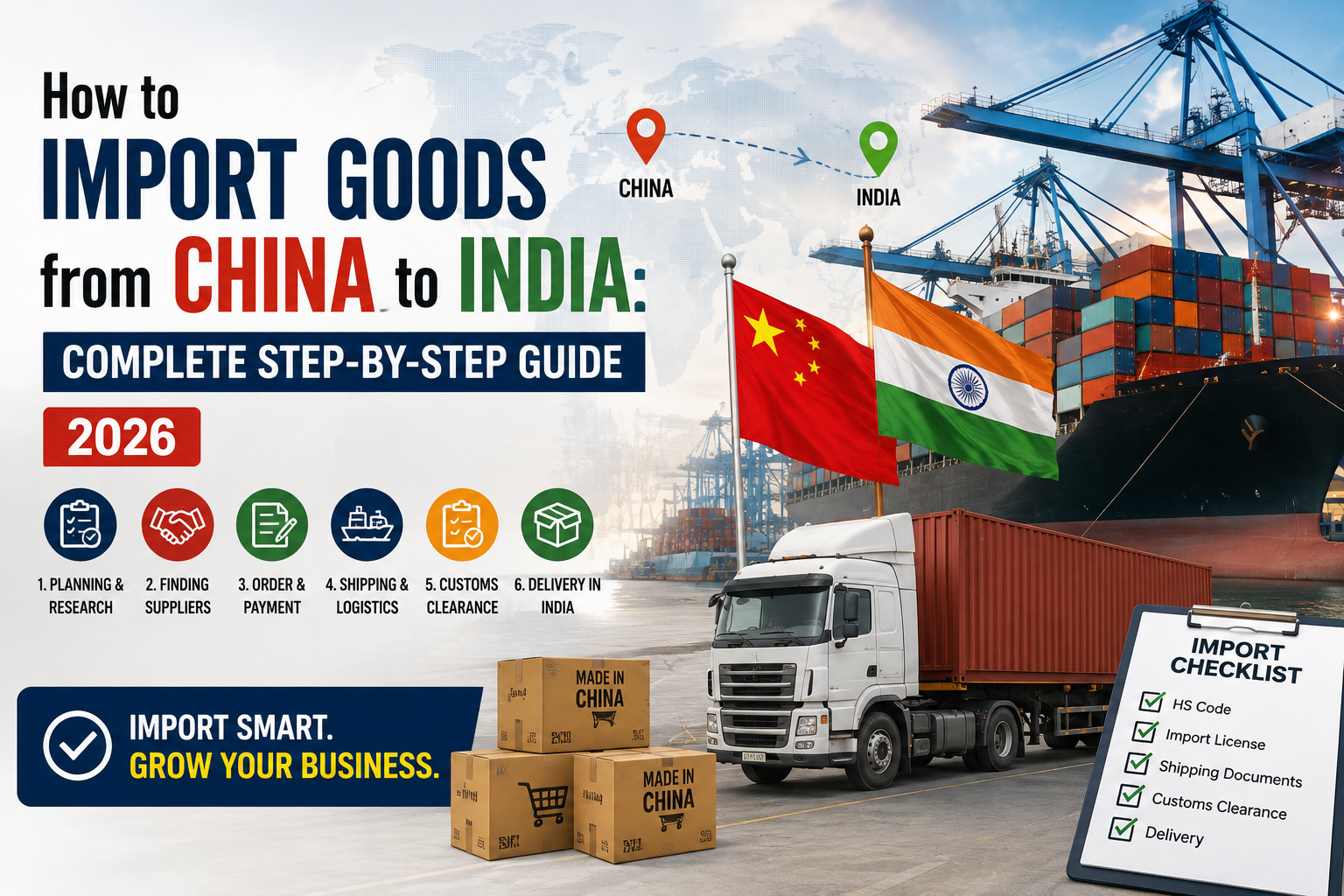
Product Research → Supplier Verification → Sample Order → Price Negotiation → IEC → HS/CTH Classification → Landed Cost Calculation → Purchase Order → Shipping → Import Documents → Bill of Entry → Customs Assessment → Duty/Tax Payment → Customs Clearance → Delivery
Following this process can help Indian businesses reduce unexpected costs, avoid unnecessary delays, and build a more reliable import operation.