Importing products from China to India has become an important business opportunity for Indian entrepreneurs, wholesalers, retailers, and manufacturers. China offers a wide range of products, competitive manufacturing costs, and multiple sourcing opportunities. However, before placing an order, importers must understand the customs duties and taxes involved in bringing goods into India.
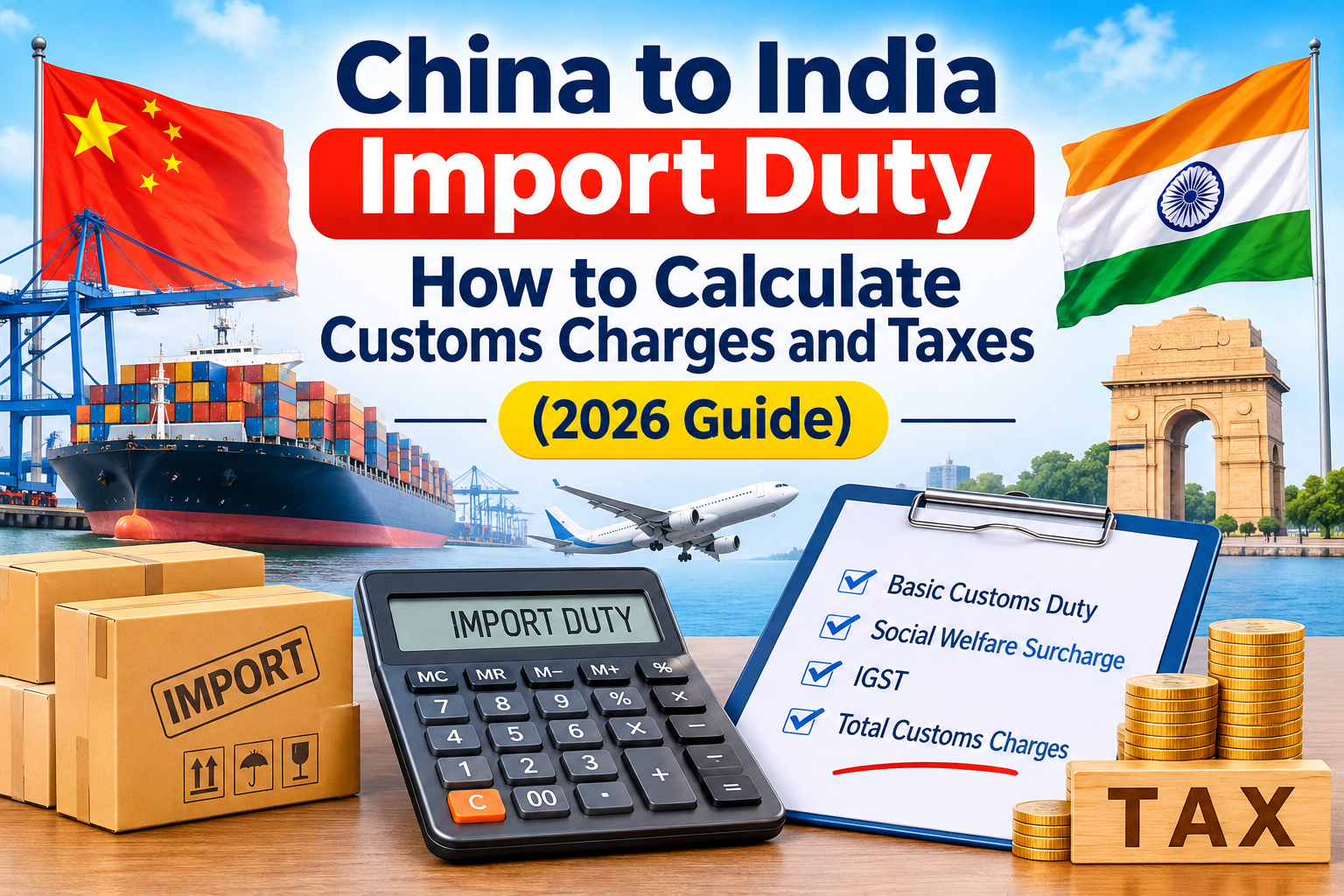
One of the most important factors affecting your total import cost is China to India import duty. Understanding how customs charges, Basic Customs Duty (BCD), Integrated Goods and Services Tax (IGST), and other applicable taxes work can help you plan your budget and avoid unexpected expenses.
In this guide, we explain how to calculate import duty from China to India, the different types of customs charges, and practical ways to estimate your total import expenses in 2026.
1. What Is Import Duty from China to India?
Import duty is a tax imposed by the Indian government on goods brought into the country from overseas markets, including China.
When products arrive at an Indian customs port or airport, customs authorities assess the shipment based on its declared value, product classification, applicable duty rates, and relevant import regulations.
The total customs charges depend on several factors:
- Type and category of imported products
- HS Code (Harmonized System Code)
- Assessable value of the goods
- Applicable Basic Customs Duty
- Social Welfare Surcharge
- Integrated Goods and Services Tax
- Additional duties or product-specific charges, where applicable
Import duty rates are not the same for every product. Therefore, checking the correct HS Code is essential before importing goods from China.
2. Types of Customs Duties and Taxes in India
Understanding the different taxes is the first step towards calculating your import expenses.
Basic Customs Duty (BCD)
Basic Customs Duty is the primary customs tax imposed on imported products. The applicable rate depends on the product’s HS Code and the current Indian customs tariff.
For example, electronics, machinery, furniture, textiles, and plastic products may have different BCD rates.
Social Welfare Surcharge (SWS)
Social Welfare Surcharge is generally calculated at 10% of the applicable aggregate customs duties, subject to exemptions and specific provisions.
It is important to remember that SWS is not automatically calculated as 10% of the product’s invoice value.
Integrated Goods and Services Tax (IGST)
IGST is charged on imported goods under India’s GST framework. It is generally calculated on the combined value of the assessable value and applicable customs duties.
The IGST rate depends on the product classification and the applicable GST rate.
Other Applicable Duties
Some products may attract additional charges, including:
- Agriculture Infrastructure and Development Cess (AIDC)
- Anti-dumping duty
- Countervailing or safeguard duties, where applicable
- Health cess or other product-specific levies
Not every imported product attracts these additional duties. The applicable notifications and tariff provisions must be checked before calculating the final cost.
3. How to Calculate China to India Import Duty
To estimate customs charges accurately, you first need to determine the assessable value of your imported products.
The assessable value generally includes:
- Product purchase price
- International freight charges
- Insurance charges
- Applicable packing, handling, and other valuation additions
Customs valuation follows the applicable provisions of Section 14 of the Customs Act, 1962 and the Customs Valuation Rules.
Step-by-Step Import Duty Calculation
Step 1: Calculate the Assessable Value
Start with the product invoice value and add the applicable freight, insurance, and other dutiable valuation elements.
Step 2: Calculate Basic Customs Duty
Multiply the assessable value by the applicable BCD percentage.
Step 3: Calculate Social Welfare Surcharge
Calculate SWS on the applicable customs duty base, subject to relevant exemptions.
Step 4: Calculate IGST
Add the assessable value and applicable customs duties to determine the IGST calculation base. Apply the relevant IGST rate.
Step 5: Calculate Total Customs Duty
Add BCD, SWS, IGST, and any other applicable customs levies.
4. Example of Import Duty Calculation from China to India
Let’s understand the calculation using a hypothetical example.
Suppose an Indian business imports products from China with the following costs:
| Description | Amount |
|---|---|
| Product value | ₹1,00,000 |
| International freight | ₹10,000 |
| Insurance | ₹1,000 |
| Assessable value | ₹1,11,000 |
For illustration, assume the following applicable rates:
- Basic Customs Duty: 10%
- Social Welfare Surcharge: 10% of BCD
- IGST: 18%
Calculation:
- Assessable Value = ₹1,11,000
- BCD = ₹1,11,000 × 10% = ₹11,100
- SWS = ₹11,100 × 10% = ₹1,110
- IGST Base = ₹1,11,000 + ₹11,100 + ₹1,110 = ₹1,23,210
- IGST = ₹1,23,210 × 18% = ₹22,177.80
Total Customs Duty = ₹34,387.80
Therefore, the estimated landed value before other applicable charges is:
₹1,11,000 + ₹34,387.80 = ₹1,45,387.80.
Note: These figures are illustrative only. Actual duty rates, exemptions, valuation adjustments, and applicable levies depend on the product’s HS Code and current customs notifications.
5. How to Find the Correct HS Code for Imported Products
The HS Code is an internationally used product classification system. Indian customs uses the applicable eight-digit Customs Tariff Item to identify imported goods and determine their duty rates.
Using the wrong HS Code can result in incorrect duty calculations, customs delays, penalties, or additional documentation requirements.
To identify the correct classification:
- Obtain the complete product description from your Chinese supplier.
- Check the product material, usage, specifications, and technical details.
- Identify the appropriate HS Code.
- Verify the applicable duty rates through the ICEGATE Trade Guide on Imports.
- Confirm whether any additional duties, exemptions, or import restrictions apply.
Always verify the classification before finalising your purchase order.
6. Documents Required for Importing from China to India
Having the correct documents helps ensure a smoother customs clearance process.
Commonly required documents include:
- Commercial Invoice
- Packing List
- Bill of Lading or Airway Bill
- Import Export Code (IEC)
- Bill of Entry
- Certificate of Origin, where applicable
- Product-specific licences or certificates, if required
- Insurance and freight documents, where applicable
Depending on the product, additional approvals from regulatory authorities such as BIS, FSSAI, or other relevant agencies may be necessary.
7. How to Reduce Import Costs When Shipping from China to India
Businesses can manage import expenses more effectively with proper planning.
Choose the Right Shipping Method: Compare air freight and sea freight based on shipment size, urgency, and total logistics costs.
Verify HS Codes Before Ordering: Confirm the correct product classification and duty rates before making payments.
Compare Supplier Prices: Evaluate multiple manufacturers to find competitive product prices without compromising quality.
Plan Shipments Efficiently: Consolidating smaller shipments can help optimise transportation expenses.
Work with an Experienced Import Partner: Professional sourcing and logistics support can help reduce documentation errors, unexpected charges, and delays.
8. Use ICEGATE to Check Import Duty Rates
The Indian Customs Electronic Gateway (ICEGATE) provides official resources for checking customs duty information.
Importers can use the ICEGATE Custom Duty Calculator and Trade Guide on Imports to research applicable customs duties using product descriptions or tariff classifications.
Since customs rates and exemption notifications can change, always check the latest applicable rates before confirming an import order.
9. Why Choose ChinaToBharat for China to India Import Support?
Importing products internationally involves multiple steps, including supplier coordination, product sourcing, shipping arrangements, documentation, and customs clearance.
ChinaToBharat helps businesses navigate the China-to-India import process with logistics and sourcing support.
Whether you are a first-time importer or an established business looking to streamline international procurement, working with an experienced import partner can make the process more organised and manageable.
From understanding shipping options to coordinating your import requirements, the right support can help you plan your purchases with greater confidence.
Frequently Asked Questions (FAQs)
1. What is the import duty from China to India in 2026?
There is no single fixed import duty rate for all products. The applicable duty depends on the HS Code, Basic Customs Duty, IGST, Social Welfare Surcharge, and other relevant levies.
2. How can I calculate customs duty from China to India?
Determine the assessable value, identify the applicable BCD rate, calculate SWS and IGST, and include any other applicable customs duties.
3. Is IGST applicable to products imported from China?
Yes. IGST is generally applicable to imported goods, subject to the relevant GST provisions and exemptions.
4. Where can I check the latest customs duty rates in India?
You can use the ICEGATE Custom Duty Calculator and Trade Guide on Imports to check applicable customs duty information.
5. Does every product imported from China have the same customs duty?
No. Different products have different HS Codes, duty rates, exemptions, and regulatory requirements.
6. Can I reduce import duty when importing from China?
You should check applicable exemptions, concessions, and tariff notifications. Correct classification and accurate documentation can also help prevent unnecessary costs. Never misdeclare product value or classification to reduce duty.
Conclusion
Understanding China to India import duty is essential for businesses that want to import products profitably and avoid unexpected expenses. By identifying the correct HS Code, calculating assessable value, understanding BCD, SWS, and IGST, and preparing the necessary documentation, importers can estimate their total import costs more effectively.
Whether you are importing electronics, machinery, textiles, furniture, or other commercial products, proper planning makes international trade easier.
Planning to import products from China to India? Connect with ChinaToBharat for import sourcing and shipping support and make your international procurement process more organised.